13 Most Valuable Vintage Pocket Knives For Collectors: A Complete Guide To The Best

Pocket knives have a long history as everyday tools and decorative personal objects. Older examples can be historically significant, but not every rare or expensive knife is vintage. Age, provenance, and documented manufacturing history matter when describing an object accurately.
This article retains 13 examples from the original list, including vintage folding knives, contemporary designs, and one fixed-blade comparison. The previously reported prices are not independently verified sale results, and the examples do not constitute a verified ranking of the most valuable vintage pocket knives.
The following sections distinguish historical examples from items whose age or classification has not been confirmed, and explain the limitations of the existing price guide.
Table of Contents
- Key Takeaways
- Most Collectible List Of Vintage Pocket Knives
- Vintage Pocket Knives Price Guide
- Vintage vs Antique Pocket Knives: Age, Era and Value
- Most Expensive Antique Pocket Knife
- What To Consider When Collecting Vintage Knives
- Historical Timeline
- Museum Image Gallery
- Historical Glossary
- FAQs
- Final Notes
- References and Editorial Sources
Key Takeaways
- The history of folding cutlery spans many centuries.
- Vintage and antique describe age, rather than price or rarity.
- A limited-edition object is not necessarily a historical artifact.
- Museum collections preserve important examples of decorative craftsmanship.
- Historical catalog records document objects and their cultural significance.
- The original article includes historical examples and contemporary designs; these categories should not be confused.
Explore the history of folding cutlery, the documented museum examples, and the historical glossary for additional context.
Most Collectible List Of Vintage Pocket Knives
Don’t miss this 13 of the most collectible pocket knives details, from classic designs to rare and limited-edition models.
1. Marfione Customs Hera D/E OTF Automatic Knife Carbon Fiber
Key Features:
- Length of Blade: 3.8 inches
- Material of Blade: M390 Steel
- Brand: Marfione Customs
- Origin: United States
- Estimated Price: Between $3,120.00 and $3,365.00 USD
This is a contemporary custom design rather than a documented vintage artifact. High-end craftsmanship and limited production do not establish an item’s age. The manufacturing date of the particular example described here has not been verified.
The carbon fiber handle gives it a distinct look while providing a sturdy grip, while the M390 steel blade ensures that it retains its sharpness for an extended period.
The Marfione Customs Hera D/E OTF Automatic Knife Carbon Fiber boasts an automatic opening mechanism, making it user-friendly and easy to operate. This knife has a sleek and stylish design, making it an attractive addition to any collection.
One of the main advantages of this knife is the high-quality materials used in its construction. This ensures its durability and longevity, making it a worthwhile investment. The automatic opening mechanism is another advantage, making it easy to use and carry.
However, one of the disadvantages of this knife is its high price, which may need to be more affordable for some collectors. Additionally, the automatic opening mechanism may not be legal to carry in some areas, limiting its use.
2. Tuch Umqua Liner Carbon Fiber Knife

Key Features:
- Length of Blade: 3.25 inches
- Material of Blade: Steel grade not independently verified
- Brand: Tuch Umqua
- Origin: United States
- Estimated Price: $3,000
This pocket knife is a remarkable piece of engineering, designed and crafted by master knifemaker Dan Tuch.
The original description identifies a carbon fiber handle but gives conflicting steel grades (CPM-S30V and CPM-S35VN). Neither grade has been independently confirmed for this particular example, so its exact blade material remains unverified.
One of the unique features of the Tuch Umqua is its dual-action auto mechanism, which allows for both manual and automatic blade opening. The knife also has a reliable liner lock that keeps the blade in place.
However, the Tuch Umqua may be lighter for some users, which is the only significant disadvantage of this pocket knife.
3. Chuck Gedraitis Custom Clever Girl Automatic Knife

Key Features:
- Length of Blade: 4 inches
- Material of Blade: Steel
- Brand: Chuck Gedraitis
- Origin: United States
- Estimated Price: $4,500
The Chuck Gedraitis Custom Clever Girl is a contemporary custom design. Uniqueness and limited production do not make an item vintage. No independently documented production date has been established for the particular example in this article.
It features a stunning blade made of Damasteel, high-performance stainless steel that is beautiful and durable. The blade has a tanto-style shape with a sharp point, making it a versatile cutting tool.
The handle of the Clever Girl is made of titanium and has a unique design that provides a comfortable and secure grip. The knife also comes with a beautiful custom stand, making it an excellent piece for display or collection. The frame is made of high-quality materials to showcase the knife’s unique features.
On the other hand, the knife’s expensive price tag may not be accessible to all buyers, which could be considered a con.
4. Vintage Remington Bullet

Key Features:
- Length of Blade: 3.25 inches
- Material of Blade: Steel; exact grade not verified
- Brand: Vintage Remington
- Origin: United States
- Estimated Price: $875
The original Remington Bullet series belongs to the interwar era, with later commemorative editions appearing decades afterward. The name refers to the cartridge-shaped shield inset into the handle, not to the shape of the entire handle. The precise date of the specimen shown here is not independently confirmed. The Remington Society of America’s reference bibliography distinguishes historical and contemporary Bullet series.
The exact steel grade and measurements of this particular specimen have not been independently confirmed. Original and later editions should not be treated as identical.
The specific locking arrangement of this specimen is not established by the available historical documentation.
5. Vintage Case XX Tested 1920-1939 Whittler 8308 Genuine Pearl Blade

Key Features:
- Length of Blade: 3.25 inches
- Material of Blade: Stainless Steel
- Brand: Case XX
- Origin: United States
- Estimated Price: $1,500
This pocket knife is a rare and highly sought-after item among collectors from the early 1920s. Its three blades are made of high-quality stainless steel, ensuring its longevity.
The handle is made of genuine pearl, adding a touch of elegance to this already beautiful knife. Its compact size of 3.25 inches makes it perfect for display or carrying in a pocket. However, its high price may be a barrier for some collectors.
However, due to its age, visible signs of wear and tear may add to its vintage charm, but it may not be suitable for some people’s tastes. Additionally, with a compact size, it may not be better for smaller hands or for those who prefer bigger knives.
6. KABAR Stag Union Cut Co PAT 1907

Key Features:
- Length of Blade: 4 inches
- Material of Blade: Carbon Steel
- Brand: KABAR
- Origin: United States
- Estimated Price: $1,175
The KABAR Stag Union Cut Co PAT 1907 pocket knife is a vintage piece from the early 1900s. The knife’s era and unique design add to its charm and appeal. The knife’s carbon steel blade is exceptionally durable, making it an ideal tool for camping, hunting, or collecting.
The knife features a handle made of a stag, which gives it a rustic look and feel. The knife also comes with a fork, making it a handy outdoor cooking tool.
On the downside, the knife may feel heavy and bulky, making it less comfortable to carry around. Also, the knife may be unavailable due to its vintage status, making it difficult to find.
7. Boker Tirpitz Liner Lock Knife Aluminum/Walnut

Key Features:
- Length of Blade: 3.5 inches
- Material of Blade: Damascus
- Brand: Boker
- Origin: Germany
- Estimated Price: $1,048
The Boker Tirpitz is a modern design with a historical theme. The age of a design’s inspiration or materials does not establish the date of manufacture of the finished object. The late-20th-century production date and discontinuation claim in the earlier text are not verified for this model.
The blade is secured by a liner lock mechanism that ensures its stability and safety during use. The Boker Tirpitz Liner Lock Knife is a testament to the manufacturer’s commitment to creating high-quality products.
However, the Boker Tirpitz Liner Lock Knife may not be suitable for heavy-duty tasks due to its lightweight construction. This means it may need help to handle tasks that require a sturdier and heavier knife.
Additionally, it may need frequent maintenance to keep the blade sharp, which could be a drawback for those who prefer low-maintenance knives.
8. Randall Made Knives-Model Knife-Bear Bowie

Key Features:
- Length of Blade: 8 inches
- Material of Blade: Stainless Steel
- Brand: Randall Made Knives
- Origin: United States
- Estimated Price: $1,850
The Randall Model 12-8 Bear Bowie is a fixed-blade knife rather than a folding pocket knife. It remains in this article as an explicitly labeled comparison from the original list, not as an example of a vintage pocket knife. The age of the particular specimen has not been verified.
The handle is made from a beautiful crown stag, which gives the knife a rustic and elegant look. The blade is designed for hunting and can be used for a variety of tasks in the field.
The elegant design of the knife adds to its aesthetic appeal, making it a collector’s item. Additionally, the knife is produced by a reputable brand known for its quality craftsmanship and attention to detail.
However, the knife’s size and weight make it unsuitable for everyday carry, which can be considered a disadvantage. Nevertheless, the knife’s overall performance and quality make it a valuable addition to any collection or a reliable tool for hunting purposes.
9. 1920 1940 Case Super Rare Teste 6151 Green Bone Banana Treapper None Better Knife

Key Features:
- Length of Blade: 4.125 inches
- Material of Blade: Carbon steel
- Brand: Case
- Origin: United States
- Estimated Price: $1,050
The Case Super Rare Teste 6151 Green Bone Banana Treapper None Better Knife was produced between the 1920s and 1940s, making it a vintage collectible. Its green bone handle and carbon steel blade stand out from other knives of its era.
At 4.125 inches, the blade is perfect for everyday carry while still being long enough to handle tougher tasks. This knife was made in the United States and is an excellent choice for anyone who values quality craftsmanship.
However, the Case Super Rare Teste 6151 Green Bone Banana Treapper None Better Knife is relatively expensive compared to other vintage knives. Collectors who prefer traditional designs may like something other than the knife’s unique look.
10. HUGE Antique Folding Dagger Bowie Knife Genuine Pearl Sculpted Bolsters

Key Features:
- Length of Blade: 6.75 inches
- Material of Blade: Steel
- Brand: Huge
- Origin: France
- Estimated Price: $3,950
The HUGE Antique Folding Dagger Bowie Knife is a vintage masterpiece with a unique and stunning design. The knife is a testament to the craftsmanship of the time, featuring genuine pearl-sculpted bolsters that add a touch of elegance to the knife’s overall appearance.
At 6.75 inches, the blade is large enough to handle serious tasks, while the genuine pearl-sculpted bolsters add a touch of elegance. This knife was made in France and is an excellent choice for collectors or enthusiasts.
On the other hand, the knife may not be suitable for everyday handling due to its size and vintage nature. However, this is a highly sought-after and valuable piece for collectors or enthusiasts that adds to any collection.
11. Case Tested XX 551 Stag Folding Bowie Knife

Key Features:
- Length of Blade: 5 inches
- Material of Blade: Carbon steel
- Brand: Case XX
- Origin: United States
- Estimated Price: $1,550
The Case Tested XX 551 Stag Folding Bowie Knife is a vintage piece from the early to the mid-20th century. Collectors covet it due to its rarity and unique features.
The 5-inch carbon steel blade is perfect for hunting and other outdoor activities, while the stag handle adds a touch of elegance. This knife comes with a sheath for easy carrying.
The history of this knife is also significant, as it was a popular tool among outdoors people and hunters during its production era. Its material and design reflect the craftsmanship and quality of knives from that era. Owning one is a way to connect with the past and appreciate the artistry of vintage knives.
One possible downside of this knife is that its blade length may be shorter than some collectors prefer. However, this may be a minor issue for those who value its historical significance and unique design features.
12. Attn2Detail Mercantile MK 3 Med Frame Lock Knife Jigged Ti

Key Features:
- Length of Blade: Not independently verified
- Material of Blade: Steel
- Brand: Attn2Detail Mercantile
- Origin: United States
- Best For: Collecting, EDC
- Estimated Price: $1,150
The Attn2Detail Mercantile MK 3 is a contemporary design, not a verified vintage example. The earlier text reported inconsistent blade lengths; the specific specimen’s date, dimensions, and exact steel grade have not been independently confirmed.
The knife features a titanium handle with a jigged texture, providing a comfortable and secure grip. It also has a frame lock mechanism that keeps the blade securely in place when open. The knife has a flipper tab that allows easy one-handed opening and a pocket clip that enables easy and secure carry.
However, the lightweight construction of the knife may not be suitable for heavy-duty tasks, which may require a more robust and sturdy knife.
13. W R CASE & SONS 1905-14 Super Rare Rogersbone Combo 6251

Key Features:
- Length of Blade: 2.5 inches
- Material of Blade: Stainless Steel
- Brand: W R CASE & SONS
- Origin: United States
- Estimated Price: $1295
This pocket knife is a vintage folding knife produced during the early 1900s. It has a 2.5-inch stainless steel blade that is durable and sharp and a fork that is attached to the handle. The handle is made of Rogersbone, a material known for its durability and attractive appearance.
The knife also features a nickel-silver bolster and pins, adding to its aesthetics. It has a slip joint mechanism that keeps the blade securely in place when open and a bail allowing easy attachment to a keychain or lanyard.
The knife’s vintage production era and rarity make it more expensive than other knives with similar features. Its specific design for outdoor activities may also limit its use to those particular situations, making it less versatile than other knives in some cases.
Vintage Pocket Knives Price Guide
The following table preserves the original article’s reported figures for reference. These figures have not been independently verified as completed sales, appraisals, or present-day market values. Several listed objects are contemporary designs, and one is a fixed-blade comparison rather than a pocket knife.
| Knife Model | Previously Reported Figure (Unverified) | Production Period / Classification |
|---|---|---|
| Marfione Customs Hera D/E OTF Automatic Knife | $3,120.00 To $3,365.00 USD | Modern design; exact date unverified |
| Tuch Umqua Liner Carbon Fiber Knife | $3,000 | Modern design; exact date unverified |
| Chuck Gedraitis Custom Clever Girl Automatic Knife | $4,500 | Modern design; exact date unverified |
| Vintage Remington Bullet | $875 | Original interwar series and later editions; specimen date unverified |
| Case XX Tested Whittler 8308 | $1,500 | 1920–1939 |
| KABAR Stag Union Cut Co PAT 1907 | $1,175 | Early 1900s (1907 patent marking) |
| Boker Tirpitz Liner Lock Knife | $1,048 | Modern design; exact date unverified |
| Randall Made Knives Model 12-8 Bear Bowie | $1,850 | Fixed-blade comparison; specimen date unverified |
| Case Tested 6151 Green Bone Banana Trapper | $1,050 | 1920–1940 |
| Antique Folding Dagger Bowie Knife | $3,950 | Not specified |
| Case Tested XX 551 Stag Folding Bowie Knife | $1,550 | Early to mid-20th century |
| Attn2Detail Mercantile MK 3 Frame Lock Knife | $1,150 | Modern design; exact date unverified |
| W.R. Case & Sons 1905–14 Rogersbone Combo 6251 | $1,295 | 1905–1914 |
Note: The figures above and the reported record-price claims later in the article are legacy claims, not independently confirmed transactions. An asking price is not evidence of a completed sale. Where the original source does not establish a production date or classification, it is marked as unverified. Museum catalogs such as the Smithsonian’s historic folding-knife record provide documented dates and materials, but do not establish market prices.
Vintage vs Antique Pocket Knives: Age, Era and Value
Collectors disagree on the line between vintage and antique pocket knives. No official rule exists.
The most common trade rule calls a knife antique at 100 years and vintage between 20 and 99 years. Some collectors lower the antique line to 75 years.
Vintage vs Antique Pocket Knives: Age Rules
The year a knife was made decides its group, and the group changes as time passes. In 2026, the cutoffs fall on these dates.
| Rule | Antique | Vintage |
|---|---|---|
| Common trade rule | 100 years or older (made 1926 or earlier) | 20 to 99 years (made 1927 to 2006) |
| Stricter collector rule | 75 years or older (made 1951 or earlier) | 25 to 74 years (made 1952 to 2001) |
The calendar years are my own arithmetic from the 2026 date. A forum thread on this topic ends with members calling the line a “gray area”. Check which rule a seller uses before you buy.
Vintage vs Antique Pocket Knives: Side by Side
| Feature | Antique | Vintage |
|---|---|---|
| Typical age | 75 to 100 years or more | 25 to 75 years |
| Typical era | Before the mid 1900s | Mid to late 1900s |
| Example makers | Winchester (1919 to 1942), early Remington UMC | Case, Schrade, Buck, Victorinox |
| Case tang stamps | 1914 to 1940 stamps, such as CASE XX TESTED and the script logo | 1940 to 1964 stamps and the 1965 “U.S.A.” stamp |
| Handles | Stag, pearl, bone, wood, celluloid | Delrin and other synthetics, plus bone and stag |
| Blades | Mostly high carbon steel | Carbon and stainless steel |
| What collectors value | Rarity, maker marks, original condition | Nostalgia, daily use, classic patterns |
Stainless steel does not mark a knife as vintage. Case used a “CASE’S STAINLESS” stamp as early as 1916. Check the tang stamp before you judge a knife by its blade.
Antique Example: Winchester Pocket Knives
Winchester made pocket knives from 1919 to early 1942. Under the 100 year rule, only knives made in 1926 or earlier count as antique.
Under the 75 year rule, all of them do. The second digit of a Winchester pattern number shows the handle material.
| Digit | Handle material |
|---|---|
| 0 | Celluloid |
| 1 | Fancy celluloid |
| 2 | Nickel silver |
| 3 | Genuine pearl |
| 6 | Cocobolo or other wood |
| 7 | Bone |
| 8 | Bone stag |
How to Tell If Your Knife Is Vintage or Antique
- Read the tang stamp and match it to the maker’s era chart.
- Check the handle material against the era.
- Compare the pattern number or logo style with the maker’s catalogs.
- Count the years back from today and apply the rule your seller uses.
Most Expensive Antique Pocket Knife
The highest-priced antique pocket knives ever sold reach $10,000 to over $25,000 for rare factory-produced American and European folders.
While antique fixed-blade daggers like the royal Mughal Shah Jahan Kard have sold for millions at auction, true antique folding pocket knives occupy a much more specialized collector market.
Top Record-Setting Pocket Knives
- 19th-Century Sheffield Exhibition Knives ($10,000 – $25,000+). Master cutlers in Sheffield, England (such as Joseph Rodgers & Sons and George Wostenholm) crafted multi-blade exhibition folding knives in the 1800s. Featuring mother-of-pearl scales, gold inlays, and up to 100 intricate blades, these museum-grade pieces regularly command five-figure sums at major auctions.
- Rare Case XX Prototypes & Tested Era ($8,500 – $14,300+). A reported record price for a vintage Case pocket knife reached $14,300 at auction. Rare one-of-a-kind sets, such as the Case XX Prototype Cotton Sampler, have also been valued at over $8,500 in mint condition.
- Case Tested XX Green Bone Whittler ($4,674). Produced between 1920 and 1940, an exceptional example of this multi-blade pattern sold at Morphy Auctions for $4,674 due to its unsharpened blades and original green bone handles.
- Pre-War Remington UMC Stockman ($3,936). Original Remington UMC knives made prior to 1940 are fiercely collected. A mint R3923 stockman pattern achieved $3,936 at auction, while rare pre-war Remington Bullet knives routinely fetch between $1,000 and $3,000+.
- Early Case Brothers & Press Button Automatics ($2,000 – $3,000+). Scarce patterns from Case Brothers (pre-1915) and early American switchblades from the Press Button Knife Co. frequently clear $2,000 to $2,500 when found in near-mint condition.
Key Factors That Drive Value
- Condition and Blade Fullness – A knife with unsharpened, factory-original blades (“full blades”) and crisp snap is worth exponentially more than a worn or heavily polished piece.
- Tang Stamps and Rarity – Early stamps from defunct makers—like Napanoch Knife Co. (closed 1919), Schatt & Morgan (original 1895–1933 run), or Miller Bros.—carry massive premiums because no authentic reissues exist.
- Handle Materials – Genuine stag, green bone, tortoiseshell, and engraved mother-of-pearl command the highest prices among collectors.
- Provenance and Packaging – Retaining the original factory box, paperwork, or documented historical ownership can double a knife’s auction estimate.
References
- Yahoo Shopping – 5 Vintage Pocket Knives Ranked by Auction Value
- YouTube – Case Pocket Knife Auction Record Breakdown
- YouTube – Joseph Rodgers & Sons Sheffield Antique Exhibition Knives
- Facebook – Collector Ranking of the 10 Most Valuable Pocket Knives
What To Consider When Collecting Vintage Knives
Collecting vintage knives can be a fascinating hobby. But it can also be overwhelming and confusing, especially for beginners. Here are some things to consider when starting your vintage knife collection.

1. Production Era
One of the most critical factors to consider when collecting vintage knives is the production era. The production era of a knife can significantly impact its rarity, value, and overall quality.
2. Material and Design
Vintage knives are often made of high-quality materials such as carbon steel, stainless steel, or Damascus steel. The design of a knife is also essential and can include features such as bone, wood, or synthetic handles, unique blade shapes, and intricate detailing.
3. Authenticity
When collecting vintage knives, it’s crucial to ensure the knife is authentic and not a counterfeit or replica. Research the knife’s production era, markings, and other features to confirm its authenticity.
4. Condition
The condition of a vintage knife is essential, as it can significantly impact its value. Look for well-maintained knives with no signs of corrosion, rust, or damage.
5. Rarity
The rarity of a vintage knife is another critical factor to consider. Knives produced in limited quantities or with unique features are often more valuable and sought-after by collectors.
6. Value
Having a budget when collecting vintage knives is essential, as prices vary widely depending on the knife’s production era, rarity, and condition.
Vintage Commemorative Pocket Knife Collection: What to Look For
A commemorative knife marks an event, a group or a milestone. Collectors judge these knives by the same checks as other vintage knives, plus the box, the paperwork and the edition number.
Most commemoratives are not rare, so condition and completeness decide the price.
Points to Be Noted
- Read the tang stamp first. It shows the maker and the era.
- Original condition matters more than shine. Sharpening lowers value.
- Check celluloid handles for decay. Gassing handles can damage nearby knives.
- A complete set with the box and papers draws more interest.
- Many commemorative runs are large, so do not assume rarity.
What to Check Before You Buy
| Check | What to look for | Effect on value |
|---|---|---|
| Tang stamp | Maker stamp and logo style. Case used oval “CASE XX TESTED” stamps from 1914 to 1920, a script logo from 1920 to 1940, and a “U.S.A.” stamp from 1965 | Confirms the maker and the decade |
| Blade condition | Scratches, chips, uneven grinds and pitting. Patina on carbon steel is character, but pitting is damage | Pitting and chips lower the price |
| Edge and finish | Original factory edge. Over-sharpening removes the original edge shape | Sharpening lowers value, even when done well |
| Action | Smooth opening and a firm lock with no play | Weak lockup lowers the price |
| Handle material | Stag, bone, pearl, wood or celluloid. Check for loose scales and stripped screws | Natural materials in good shape hold value |
| Celluloid decay | Tarnish at the handle and bolster joint, or on liners | Decay can spread to other knives |
| Emblems and shields | Inset shields, engraved logos or event marks | Part of what makes the knife commemorative |
| Box and papers | Original box, tin, tube or paperwork | A complete set draws more interest |
| Edition number | A serial number or stamp such as “157 of 250” | Limited runs can help, but only with real demand |
Celluloid Handles: Why They Need a Closer Look
Older celluloid handles can break down and release gas. That gas can tarnish blades and liners. Forum collectors advise keeping a suspect knife apart from other celluloid knives.
Check the joint between the handle and the bolster over the next few weeks. If no tarnish shows after about a month, the knife is probably fine.
Some patterns are less stable than others. Candy stripe, Christmas tree and cracked ice patterns are among the least stable. The yellow Case material from the Tested and XX era often breaks down.
Edition Numbers and Rarity
Record any serial or edition number. Do not pay extra for a number alone. One collector notes that Case commemorative runs often reach the thousands, so these knives often “don’t end up being that rare or valuable”.
Rarity helps only when collectors still want that brand and event.
Cleaning and Sharpening
Do not buff out patina or polish a vintage knife yourself. Collectors who want original condition pay less for a knife that has been sharpened.
A user who plans to carry the knife cares less. Visible wear can hurt the price more than a clean sharpening. A rare knife can still sell well after use.
References
- Artisan Cutlery. Knife collecting guide: how to evaluate, document and protect your knives
- All About Pocket Knives forum. Is this knife gassing out or just dirty?
- Blade Forums. Knife sharpening: retaining value
- Blade Forums. Commemorative Knives
- Case Knives. Tang stamps
Historical Timeline
A brief history of folding cutlery, illustrated by selected surviving objects rather than a comprehensive account of inventions.
- 2nd–3rd century AD — Roman period: London Museum catalogs a folding personal-care utensil from the Roman era, made of iron and ivory. London Museum record.
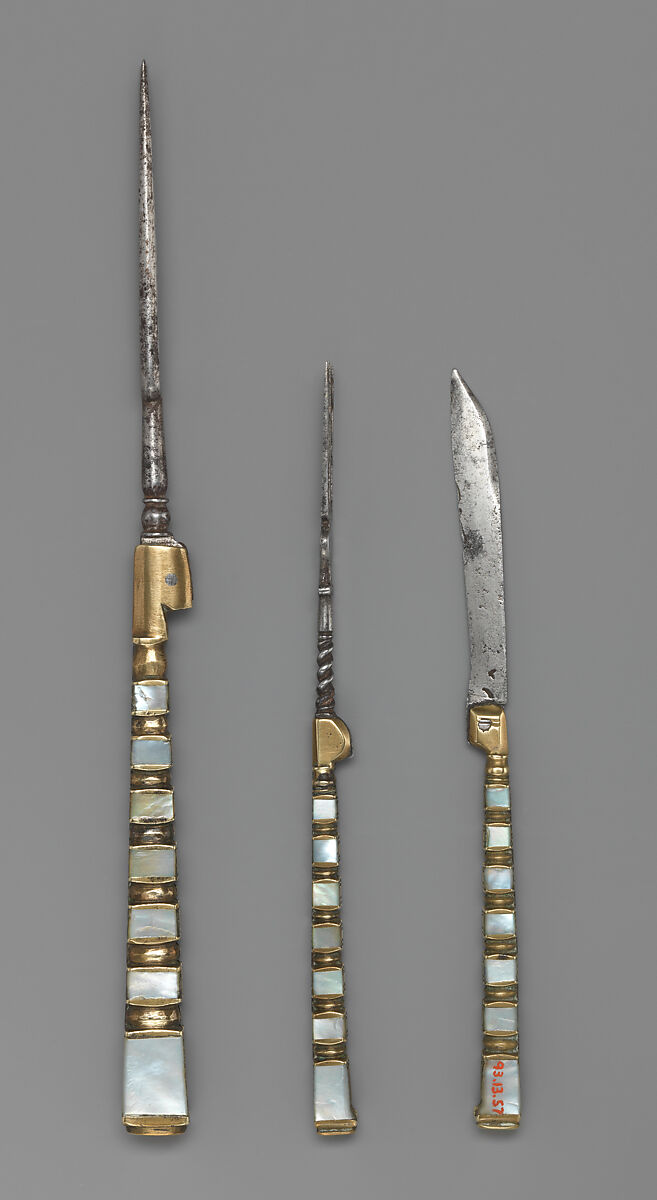
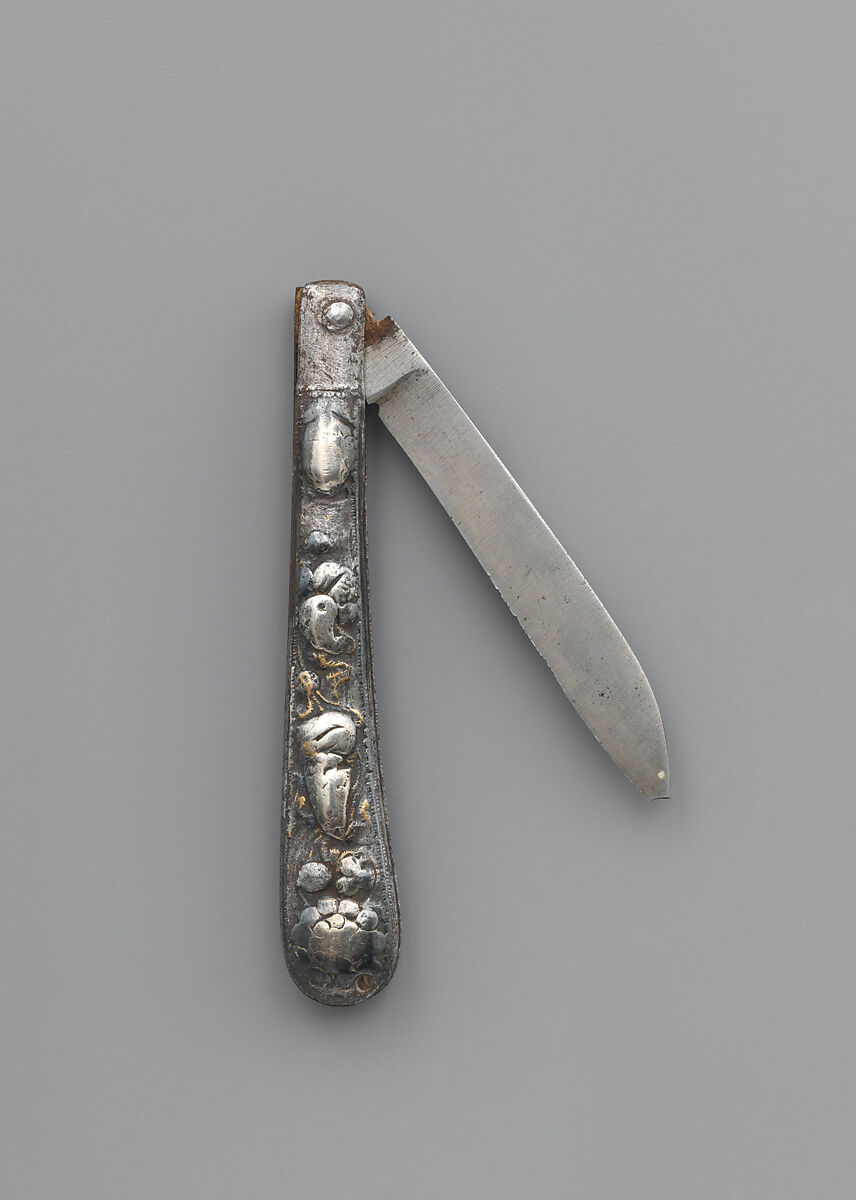
- Early 17th century — European craftsmanship: A folding object with mother-of-pearl decoration in The Met’s collection illustrates early modern European metalwork. Its attribution to Italy is tentative. The Met record.
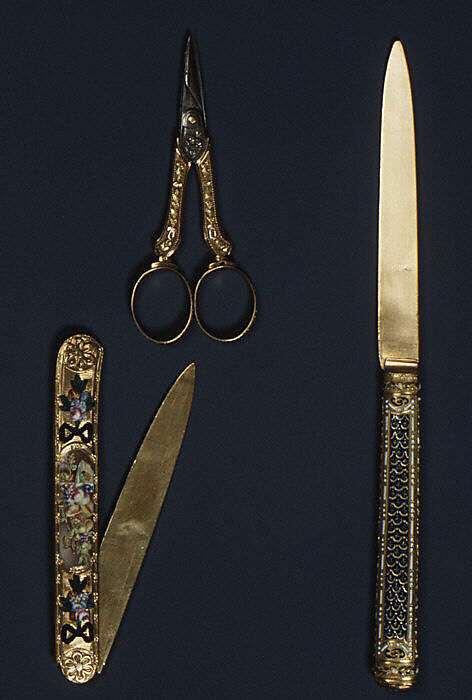
- 1761–1762 — French decorative arts: A Parisian example combines gold and enamel, illustrating the importance of ornament in personal belongings. The Met record.
- Circa 1880 — American manufacturing: A Smithsonian cutlery record identifies Bridgeport, Connecticut, as the place of manufacture. Smithsonian record.
- 1920s — Maritime souvenirs: The Smithsonian preserves a souvenir associated with the passenger ship SS Leviathan, illustrating the connection between personal belongings and transatlantic travel. Smithsonian record.
See the museum image gallery and editorial sources for related documentation.
Museum Image Gallery
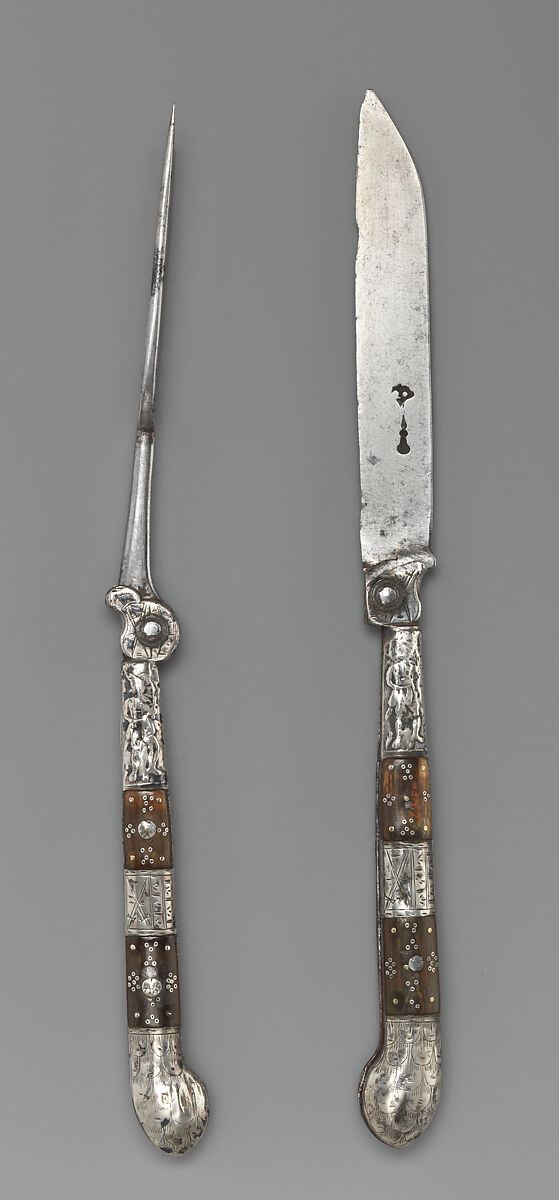
Historic folding cutlery from The Metropolitan Museum of Art. These images illustrate documented museum objects and are separate from the original 13 examples. The museum does not endorse this article.
Historical Glossary
- Antique: An object from an earlier historical period, commonly understood as at least 100 years old in many contexts.
- Vintage: An object associated with a recognizable earlier period. Definitions of age vary.
- Provenance: The documented ownership and history of an object.
- Accession Number: A museum identifier assigned to an object when it enters a collection.
- Catalog Record: A museum entry describing an object’s documented characteristics and historical context.
- Mother-of-Pearl: The naturally iridescent inner layer of certain mollusk shells, historically used in decorative arts.
- Enamel: A glass-based decorative coating found on historical metalwork.
- Patina: A surface appearance that develops over time through aging or environmental exposure.
- Public Domain: Material that is not restricted by copyright.
- CC0: A designation used to waive copyright and related rights to the extent legally possible.
Return to the table of contents or continue to the frequently asked questions.
FAQs
Here are a few related questions you might be asking yourself right now.
Q1: How do I know if a vintage pocket knife is authentic?
You can authenticate a vintage pocket knife by examining its materials, design, and markings and consulting with field experts.
Q2: Can vintage pocket knives be used for everyday tasks?
While you can still use vintage pocket knives for everyday tasks, they are generally not recommended as they may be fragile and lose their value if damaged.
Q3: Does a limited edition automatically qualify as vintage?
No. A limited production run describes quantity, not age. The date of manufacture must be documented before an object can reliably be described as vintage.
Q4: Is every historical knife a pocket knife?
No. A fixed-blade knife and a folding pocket knife are different categories. Historical importance alone does not make an object a pocket knife.
Q5: Do museum catalogs establish current prices?
Generally, museum records document historical context, dates, materials, and provenance. A catalog entry does not itself establish a market value.
Final Notes
The original list brings together several historical folding knives, some modern designs, and a fixed-blade comparison. They should not be treated as a verified ranking of the most valuable vintage pocket knives.
Distinguishing documented history from unverified descriptions helps preserve the accuracy of the article. Rarity alone does not establish age, and a reported price does not establish a completed sale.
For further historical research, consult museum catalog records and reliable historical publications. Where a date, material, or reported figure cannot be confirmed, it is better to acknowledge that uncertainty than present an estimate as fact.
References and Editorial Sources
The additional historical sections draw on publicly accessible museum catalog records and cultural heritage documentation.
- London Museum — Roman-period object
- The Metropolitan Museum of Art — early European folding cutlery
- The Met — Swiss or German folding cutlery
- The Met — French decorative arts
- The Met — Savoy clasp knife
- Smithsonian Institution — Bridgeport manufacturing history
- National Museum of American History — SS Leviathan souvenir
- The Met — Open Access image and data policy
Editorial note: Museum records establish historical context, documented dates and materials. They do not establish current market values. The four gallery photographs are marked Public Domain by The Met; the original article images have separate, unverified reuse rights. The Roman and Smithsonian records are linked for historical context only; their restricted photographs are not reproduced in the gallery.
Return to the table of contents.