Knife Laws in Ireland: Carry Rules, Bans & Penalties

Like other popular countries, Ireland has some distinctive laws, and they are quite strict about carrying knives.
So what are the Ireland Knife Laws? Generally, you can’t carry a knife with a blade longer than 3.1 inches without reasonable cause or law permission. If you don’t follow this law, you may end up in jail or pay a hefty fine.
Read along to learn about illegality in several cases, penalties, knife law exceptions, etc., in Ireland.
Quick Legal Facts
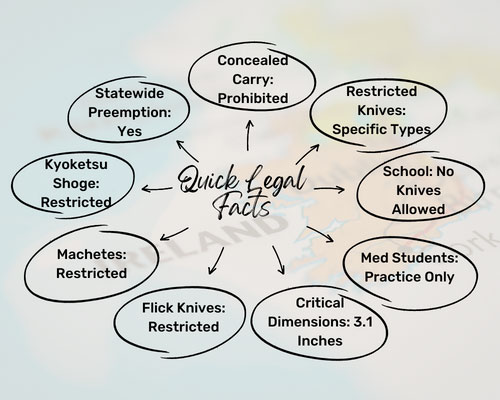
Statewide Preemption: Yes
Concealed Carry: All citizens of Ireland are prohibited from carrying a concealed knife in public places
Restricted Knives: There are some specifically restricted knives, such as flick knives, knuckle dusters, kusaris, machetes, kyoketsu shoge, butterfly knives, push daggers, etc.
Schools: All types of knives are illegal to carry on school premises. However, med students can carry knives for practice purposes only.
Critical Dimensions: A knife over 3.1 inches in blade length
Knife Laws In Ireland – What Can You Carry
Ireland is very strict about carrying a knife. When a person carries a knife or any other object with a blade or sharply pointed structure in public places, he is guilty of an offense.
However, federal law prohibits flick knives or switchblades in Ireland, and other knives may be carried with a strong and convincing reason.
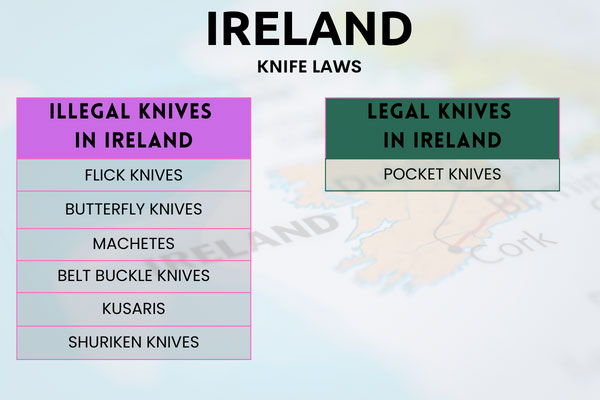
List Of Illegal Knives In Ireland
You should be careful while buying or carrying a knife with you in Ireland. It’s because the list of illegal knives is quite long. For example,
- Flick knives or switchblades
- Butterfly knives
- Machetes
- Belt buckle knives
- Kusaris
- Shuriken knives, etc.
How can you carry a small knife for your essential household tasks? You can carry it home if it’s packed and follows the legal knife length.
Furthermore, there are other scenarios where carrying a knife can put you in jail for the long term. Such as:
Illegality In Certain Areas
Carrying knives in school is totally prohibited for students. If any student is found in school with a knife or sharp article, he’ll be arrested without a warrant, according to the Police and Criminal Evidence Order 1989.
Moreover, there are some other obvious places where you can’t carry knives, such as – Courts, hospitals, police stations, Governmental buildings, airports, shopping malls, public bars, etc.
Besides, no one can carry a knife in Irish towns without good reason or lawful authority. If anyone is found with a knife without such excuse, that person shall be fined or imprisoned.
Illegality Based On Concealed Or Open Knives
Some types of knives are prohibited in Ireland by law; concealed and open knives are included in that list.
According to the law of S.I. No. 66/1991, you can’t keep concealed or open knives with you outside your home. However, if you can arrange legal authority from the local government, you can carry these knives without any problem.
Also, if your profession is related to such knives, you can carry them for “a few days” without a verified permit. And then you’ll be required to get permission papers.
Illegality of Carrying, Possession, Selling, Manufacturing, Importing, & Trading
According to Knife Laws In Ireland, a person will be found guilty of an offense if he —
- Wants to sell, manufacture, hire, or offer this offensive weapon
- Wants to repair or modify
- Keeps it in possession with the purpose of sale
- Displays with the purpose of lending it to someone
However, you can import, manufacture, and sell legal knives within legal lengths if you have a license. But you can’t issue a license as a minor or under 16.
Illegality to The Degree Of Significance, Such As Impact on Interstate Commerce Knowingly transporting or distributing offensive knives like-
- Swordsticks, hand and foot claws, flick knives, butterfly knives, sword umbrellas, or any other knives containing blades longer than 8 cm are illegal across borders.
However, pocket-friendly knives are legal in Ireland; therefore, you can distribute them. But remember that other countries should also be able to obtain knives legally.
Otherwise, you may be subject to hefty fines or other legal action due to illegal interstate commerce.
Illegality for Minors
You can only keep legal knives depending on the size and type of knife. Legal knives blades are 8 cm in length, and pocket knives are legal to carry for everyone, including minors.
However, you can’t sell or lend legal and illegal knives under 16 as a minor.
Illegality Based On Length Of Knife
Knife length is a significant factor to consider when possessing or carrying knives in Ireland. This factor applies to both adults and minors. So what size knife is legal to carry in Ireland?
The blade length of the knife should be under 7.62 cm or 3 inches. Anything more than this measurement is an illegal length of knife in Ireland.
However, if the entire length of the knife, including the handle, is 5 inches or more, you can carry it as long as the blade length doesn’t cross 3.1 inches.
Illegality In Local Governments
There is barely any information found regarding local government laws about knives.
But according to some forum users, the local government won’t create any issues if you have a good reason or permission to carry illegal knives. And carrying a legal knife is totally fine.
Penalties For Carrying Knives Illegally
In Ireland, you’ll be subject to punishment or fine just by simply carrying a knife without any solid reason and without committing any crime with it.
The Northern Ireland government doubled prison sentences to four years in 2008 due to a public outcry over excessive knife-related crime. Also, the guilty person can be charged with paying a £1,000 fine instead of going to jail.
And if anyone is found selling a knife or similar article to a minor or person under the age of 16 years, he’ll be put in jail for 6 months or charged with paying a hefty fine.
List Of Legal Knives
Generally, there is no law against carrying, buying, selling, or manufacturing pocket knives.
The typical blade length of a pocket knife is between 5 to 15 cm, so it’s easy to find the legal blade length for this knife in Ireland.
Exceptions In The Knife Law Of Ireland
Here are all the exceptions in the knife laws of Ireland —
- Anyone can carry an 8 cm long pocket knife
- Medical students or assistants can carry knives
- Police Officers or people working in a fight crime field can carry a knife
- Anyone working or in training in the military can carry knives
- Certified prison guards, material-cutting workers, hospital workers, and asylums workers can carry knives
- Firefighters and other safety department workers can carry knives
- Probation or parole officers can carry knives
- On-duty wardens and superintendents can carry knives
- Anyone who completes a certified course in handling knives and firearms can carry knives and firearms
List Of Relevant Laws
S.I. No. 66/1991: Description of offensive weapons
S.I. No. 66/1991: Illegal manufacture, import, and selling
Guidelines for Sale of Knives in Ireland
The guidelines for sale of knives in Ireland differ from the rules in the UK, and many online guides mix them up. Irish law does not license knife shops, and it sets no legal minimum age for buying an ordinary knife.
It does ban the sale of specific weapons, and it makes it an offence to carry a knife in public without a good reason.
This section covers the sale of ordinary knives, age limits, what retailers should do, and the knives nobody may sell. It covers the Republic of Ireland only.
Knife Sale
The main law is the Firearms and Offensive Weapons Act 1990. Irish law deals with knives in two ways.
- Ordinary knives: Kitchen knives, utility blades, fishing knives, camping knives, craft blades and trade tools can be sold in shops and online. No special retail licence is needed.
- Prohibited weapons: Section 12 of the Act bans the manufacture, import, sale, hire, lending and display of specified weapons. The Minister for Justice sets that list by order.
The law also covers what happens after the sale. Under section 9, it is an offence to carry a knife or any article with a blade or sharp point in a public place.
The buyer has a defence if they have good reason or lawful authority, or if the knife is for work or a recreational purpose. Good retailers tell buyers this at the till.
Age Restrictions
Irish law sets no minimum age for buying a knife. The 1990 Act has no age-restricted knife sale rule in force. The common rule that you must be 18 to buy a knife comes from UK law, and it does not apply in the Republic of Ireland.
A shop can still set its own policy. Many Irish retailers refuse to sell knives to under 18s, and some use Challenge 21 or Challenge 25 to check a buyer’s ID.
These are company rules, not legal duties. Age does not change the carrying offence, which applies to anyone in a public place.
| Question | Answer in the Republic of Ireland |
|---|---|
| Is there a legal minimum age to buy a knife? | No |
| Can a shop set a minimum age? | Yes, as store policy |
| Does age change the public carrying offence? | No |
Retailer Responsibilities
The law places no detailed duties on shops that sell ordinary knives. Still, these steps are sensible and reduce risk. Treat them as good practice, not legal requirements.
- Secure display: Keep sharp blades in locked cabinets, behind the till or on secured hooks.
- Staff training: Train staff on the prohibited list and on any store age policy. Use till prompts to flag bladed items.
- Right to refuse: A shop can refuse any sale. Staff should decline if a buyer looks intoxicated or agitated, or says they plan to use the blade unlawfully.
- Refused sales log: Keep a written note of refused sales if your policy needs one.
- Online sales: Check age if your store has an age rule, and ask couriers to confirm the recipient on delivery.
- Company liability: Under section 12, directors, managers and other officers can also be liable if a company offence happens with their consent, or through their neglect.
Prohibited Knife Sales
Under section 12, it is an offence to manufacture, import, sell, hire, lend or display a prohibited weapon. The order made under that section lists these weapons.
Prohibited Knives and Blades
- Flick knives, including knives opened by a button, spring or lever
- Gravity knives and other blades released by gravity or centrifugal force and locked open
- Balisong or butterfly knives
- Push daggers
- Belt buckle knives
- Swordsticks and dagger canes
- Sword umbrellas
- Machetes
Other Prohibited Weapons
- Knuckledusters
- Footclaws and handclaws
- Shuriken (throwing stars)
- Hollow kubotans
- Telescopic truncheons
- Blowpipes and blow guns
- Kusari gama, kyoketsu shoge, manrikigusari and sap gloves
Penalties for Selling Prohibited Weapons
A section 12 offence carries a fine of up to €5,000, up to 12 months in prison, or both, on summary conviction. On conviction on indictment, the penalty is a fine, up to 10 years in prison, or both. A 2024 change raised the prison term to 10 years.
Samurai swords and katanas are not on the list in the order. Check current law and the order before you stock any sword.
Northern Ireland
According to knife law, what I can carry In northern Ireland? Northern Ireland follows UK law, with its own rules on selling knives. This section does not cover it.
References:
- Firearms and Offensive Weapons Act 1990, revised text (Law Reform Commission)
- Firearms and Offensive Weapons Act 1990 (Irish Statute Book)
- Offensive Weapons Order 1991, S.I. No. 66 of 1991 (Irish Statute Book)
- Courts, Civil Law, Criminal Law and Superannuation (Miscellaneous Provisions) Act 2024 (Irish Statute Book)
- Knife Laws in Ireland: Carrying, Penalties and Garda Searches (RecordingLaw)
Is It Illegal To Import Knives To Ireland?
Importing standard domestic, culinary, or work knives into Ireland is legal, but importing any knife classified as a prohibited “offensive weapon” under Irish law is strictly illegal and carries severe criminal penalties.
Knife importation in the Republic of Ireland is regulated primarily under the Firearms and Offensive Weapons Act, 1990 and enforced at the border by Irish Revenue.
Knife Import
Everyday bladed tools intended for lawful domestic, occupational, or recreational use can be imported into Ireland without a special import license:
- Permitted blades. Standard kitchen knives, professional chef knives, trade utility blades, and non-prohibited camping, fishing, or folding pocket knives (such as a standard Swiss Army knife) are legal to bring into the country.
- Postal and courier shipments. Ordering permitted knives from abroad is legal, though shipments from outside the EU are subject to Irish customs declarations, VAT, and applicable import duties.
- Passenger luggage. If you are traveling into Ireland by air with permitted blades (e.g., chef knives or multi-tools), they must be packed strictly in checked-in hold luggage—carrying any blade in cabin/hand baggage is prohibited under aviation security rules.
Customs Restrictions
Border controls are enforced by Irish Revenue (Customs), which holds broad authority to inspect incoming mail, freight, and passenger baggage:
- Inspection and seizure. Customs officers routinely scan and open international parcels and luggage. Any prohibited weapon discovered at the border is immediately seized, and the case is referred to An Garda Síochána (Irish police) for criminal investigation.
- Accurate declaration requirements. Falsely labeling a parcel containing blades as “tools,” “camping gear,” or “gifts” to bypass border screening is a separate customs offense that can result in fines and prosecution.
- Northern Ireland distinction. Northern Ireland is part of the United Kingdom and is governed by UK border rules and the Offensive Weapons Act 2019, which strictly bans the delivery of bladed products directly to residential addresses from overseas sellers.
Prohibited Weapons Import Provisions
Under Section 12 of the Firearms and Offensive Weapons Act, 1990 and the Offensive Weapons Order 1991, it is a serious criminal offense to import prescribed offensive weapons into Ireland:
- Banned items. Prohibited imports include flick-knives (switchblades), gravity knives, butterfly knives (balisongs), push daggers, disguised or concealed blades (such as sword-sticks or belt-buckle knives), machetes, throwing stars, and samurai swords (katanas, except under narrow statutory exemptions for licensed collectors or recognized martial arts organizations).
- Penalties. Following sentencing increases enacted under the Courts, Civil Law, Criminal Law and Superannuation (Miscellaneous Provisions) Act 2024, anyone convicted of importing a prohibited weapon into Ireland faces a maximum penalty of up to 10 years in prison.
Reasonable Cause to Suspect and Search for Knives in Ireland: Case Law
In Ireland, Gardaí can only stop and search someone for a knife without a warrant if they have specific, objective “reasonable cause to suspect” unlawful possession.
General knowledge of crime in an area is not enough, as confirmed by Irish High Court case law.
Police Search Powers
Under Section 16 of the Firearms and Offensive Weapons Act, 1990 (as amended by Section 41 of the Criminal Justice (Miscellaneous Provisions) Act 2009), An Garda Síochána holds statutory powers to search without a warrant when investigating suspected knife offenses:
- Personal search and detention. If a Garda suspects with reasonable cause that a person in a public place is carrying a knife or offensive weapon in breach of Section 9 or 9A, the officer may search that person and detain them for whatever time is reasonably necessary to carry out the search.
- Vehicle, vessel, or aircraft search. Gardaí may stop and search any car, van, vessel, or aircraft where they reasonably suspect an unlawful blade may be found, and require the person in control to keep the vehicle stationary during the search.
- Group searches. Under Section 16(3), if a Garda reasonably suspects that at least one person within a group in a public place is carrying an unlawful weapon, the officer may search any member of that group if necessary to identify who holds the item.
- Private premises warrants. Under Section 15 of the 1990 Act, searching a private home or premises requires a search warrant issued by a District Court Judge or Peace Commissioner based on sworn information showing reasonable grounds.
Reasonable Suspicion
Irish courts require “reasonable cause to suspect” to meet both a subjective and an objective standard before a warrantless search is lawful:
- Individualized, objective basis. A Garda cannot search someone on a mere hunch or “fishing expedition.” There must be concrete facts or intelligence linking that specific person or vehicle to suspected unlawful possession (such as visible bulges, suspicious behavior, reliable witness reports, or Garda intelligence).
- Duty to inform the suspect. While a Garda does not have to cite the exact section and year of the statute at the roadside, Irish constitutional and case law requires the officer to inform the individual in plain terms of the general reason for the stop and search.
- Exclusion of unlawfully obtained evidence. If a search is conducted without valid reasonable suspicion, any knife discovered during that search risks being ruled inadmissible in court under Ireland’s exclusionary rule for unconstitutionally or unlawfully obtained evidence.
Knife-related Case Law
Key Irish court rulings illustrate how judges scrutinize Garda search powers and the statutory elements of knife offenses:
- DPP (Garda O’Higgins) v. Farrell [2009] IEHC 368. Brian Farrell was stopped in his car in Clondalkin, Dublin, and searched under drug legislation primarily because the area had a known drug problem and his address was outside the neighborhood. Gardaí found a sharply pointed knife in the car, leading to a conviction under Section 9(1) of the Firearms and Offensive Weapons Act, 1990. On appeal by case stated, High Court Judge Clark overturned the conviction, holding that general knowledge of local crime without specific, individualized suspicion toward the driver failed to establish “reasonable cause,” rendering the search unlawful.
- Constitutionality of the “Good Reason” Burden of Proof. In judicial review challenges to Section 9 of the 1990 Act (reported by Decisis.ie), the High Court upheld the rule placing the evidential burden on the accused to prove “good reason or lawful authority” once a knife is lawfully found in public. The Court found that shifting this evidential burden is a proportionate legislative measure to combat knife crime and does not violate constitutional protections against self-incrimination.
FAQ’s
Let’s answer some common questions.
Q: Are Bowie Knives Legal In Ireland?
In the Republic of Ireland, standard Bowie knives are legal to own at home, purchase, and import, but it is strictly illegal to carry one in a public place without a “good reason” or “lawful authority.”
Like flick-knives, butterfly knives, or machetes, traditional fixed-blade hunting or camping knives like a Bowie knife are not listed as banned offensive weapons under the Firearms and Offensive Weapons Act, 1990 (Offensive Weapons) Order, 1991.
However, because of their large, fixed-blade design, carrying or using one in public faces heavy scrutiny under Section 9 of the Firearms and Offensive Weapons Act, 1990.
Q: Overview Of Kujang Knife Legality In Ireland
In the Republic of Ireland, a traditional Kujang knife is legal to own inside a private home, as it is not explicitly named on Ireland’s statutory list of banned offensive weapons, but carrying one in public without a “good reason” or “lawful authority” is strictly illegal.
A Kujang is a curved, traditional Sundanese blade from West Java, Indonesia, historically used as an agricultural tool, ceremonial item, or weapon.
Under Irish law, its legality depends entirely on where it is kept, how it is used, and how it is classified at the border or by Gardaí under the Firearms and Offensive Weapons Act, 1990.
Q: Can You Have a Knife on a School Campus?
No, you cannot carry a knife on a school or college campus in Ireland unless you have a legitimate educational or work-related reason (such as a culinary arts student or maintenance worker), as campuses are treated as public places under Irish law and strictly enforce zero-tolerance weapon policies.
Under the Firearms, Irish law applies the same strict public-place restrictions to school grounds, universities, and further education campuses—regardless of blade length or folding mechanism.
Q: Can a Farmer Carry a Penknife in Ireland?
Yes, a farmer in Ireland can legally carry a penknife while actively working on farmland or traveling directly for agricultural duties, because farming qualifies as a valid “good reason” under Irish law.
Under Section 9 of the Firearms and Offensive Weapons Act, 1990, it is illegal to carry any knife, including a small folding penknife or Swiss Army knife, in a public place without “good reason or lawful authority.” However, the law specifically accounts for occupational tools.
Q: Can You Carry a Fork and Knife on the Irish Luas?
You cannot openly carry or use a metal fork and knife on Dublin’s Luas tram system, as Luas Bye-Laws strictly ban possessing any knife on board and prohibit eating, though transporting wrapped, newly bought cutlery or a packed lunch in a bag is generally tolerated if you have a valid reason.
Whether you can have cutlery with you on the Luas depends on two separate sets of rules: Luas passenger bye-laws and Irish national knife laws.
Q: Can You Carry a Knife in Ireland If You’re a Trained First Aider?
Being a trained first aider in Ireland does not give you a blanket right to carry a knife in public. However, carrying a blunt-tipped rescue tool or trauma shears inside a first-aid kit is generally accepted when you are actively on duty or traveling directly to or from a first-aid role.
Under Section 9 of the Firearms and Offensive Weapons Act, 1990, Irish law bans carrying any knife or sharply pointed article in a public place without a “good reason or lawful authority.” Your training alone is not an automatic exemption, so what you carry and when you carry it matter.
Q: Do People in Ballinasloe Carry Pocket Knives?
No, people in Ballinasloe do not routinely carry pocket knives in daily life, because national Irish law strictly bans carrying any knife in public without a specific work, farming, or outdoor reason.
Ballinasloe, in County Galway, is governed by the exact same national legislation as the rest of the Republic of Ireland
Conclusion
So you now have good knowledge about the Ireland knife laws. There is a long list of illegal knives in Ireland, such as flick knives, dagger canes, knuckle dusters, belt buckle knives, hollow kubotans, kusaris, concealed knives, etc.
However, pocket knives and other types of knives with a maximum blade length of 8 cm are legal to carry.
But anyone who needs to carry a knife for their profession of any size shouldn’t be worried as they have a valid reason.