
Best Solar Battery Storage for Home Backup and Off-Grid Use
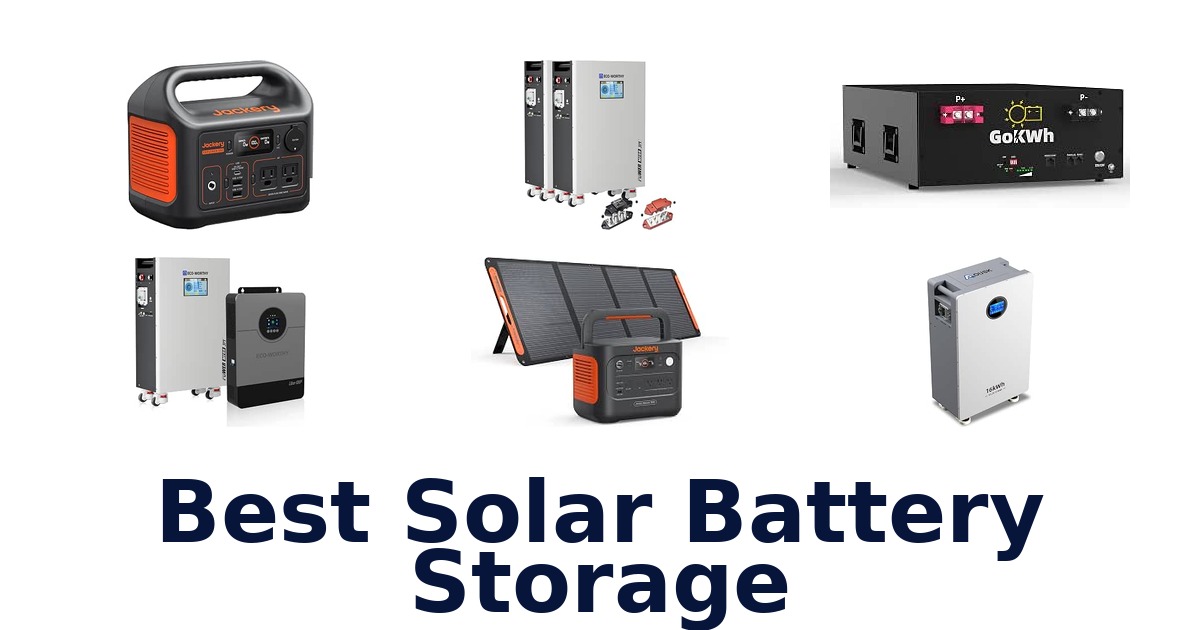
A strong solar battery storage choice pairs enough usable capacity with an inverter and voltage compatible with your system, making it suitable for home backup or off-grid power. For a ready-paired high-capacity option, the ECO-WORTHY Powermega 48V 314Ah inverter system combines a 16.1kWh battery with a 10kW hybrid inverter. The other products span standalone 48V batteries, a two-battery listing, and portable power stations, so they serve different installation needs.
Capacity alone does not determine whether a battery will work in your setup: inverter compatibility, output limits, and the amount of energy you need to store all matter. This roundup ranks each option by its fit for solar energy storage, then considers its listed capacity, power equipment, and portability.
The ECO-WORTHY Powermega 48V 314Ah inverter system is the best overall fit because it combines a 16.1kWh LiFePO4 battery with a 10kW hybrid inverter. Its listed RS485, CAN, and RS232 communication support and 10-year warranty add useful system-level details. It suits buyers seeking a substantial home backup or off-grid setup in one listing.
Check that its 48V input and 240V AC output fit your installation before choosing it.
Our Top Picks
 Best Overall
Pairs a 16.1kWh LiFePO4 battery with a 10kW hybrid inverter, plus RS485, CAN, and RS232 communication support for a substantial home storage setup.
View on Amazon High-Capacity Battery
Offers 314Ah capacity, a 200A BMS, and up to 6,000 cycles at 80% state of health; buyers must pair it with compatible system equipment.
View on Amazon Parallel Expansion
The listing describes a 48V 314Ah UL 1973-certified LiFePO4 battery and says the system supports expansion to as many as 15 units in parallel.
View on Amazon- Rack-Mount Format GOKWH 48V rack battery
- Portable Solar Kit Jackery Solar Generator 1000 v2
Compare battery storage options by use and system fit
| # | Product | Weight | Dimensions | Warranty Description | Buy |
|---|---|---|---|---|---|
| 1 | 1. ECO-WORTHY Powermega systemBest Overall | 293.2 lb | 32.56"L x 20.47"W x 9.92"H | 10 years | View on Amazon |
| 2 | 2. AOUSK 48V 314Ah batteryHigh-Capacity Battery | 291 lb | 20.08 x 10.87 x 33.54 in | 5 | View on Amazon |
| 3 |  3. Dawnice 16kWh batteryWall-mounted home battery | — | 27"L x 15"W x 35"H | 10 years | View on Amazon |
| 4 | 4. ECO-WORTHY Powermega 2-packParallel Expansion | — | — | 10 years | View on Amazon |
| 5 |  5. GOKWH 48V rack batteryRack-Mount Format | 103.6 lb | 21 x 15 x 7.08 in | 5-Year Warranty | View on Amazon |
| 6 |  6. Jackery Solar Generator 1000 v2Portable Solar Kit | 23.8 lb | 12.87"L x 8.82"W x 9.72"H | 2 year manufacturer | View on Amazon |
| 7 |  7. Jackery Explorer 300Lightweight campsite power | 7.1 lb | 9.1 x 5.2 x 7.8 in | 3+2 | View on Amazon |
Detailed Reviews: Best Solar Battery Storage
#1 · Best Overall
1. ECO-WORTHY Powermega system
- Weight: 293.2 lb
- Dimensions: 32.56"L x 20.47"W x 9.92"H
- Warranty Description: 10 years
Best for: Integrated inverter home backup.
Why it ranks #1: Pairs a 16.1kWh LiFePO4 battery with a 10kW hybrid inverter, plus RS485, CAN, and RS232 communication support for a substantial home storage setup.
The included 10kW hybrid inverter is the ECO-WORTHY Powermega system’s key distinction, pairing 16.1kWh of usable energy with a 48V 314Ah UL 1973-certified LiFePO4 battery. That combination is aimed at home backup, solar storage, and off-grid use rather than portable charging.
The 10kW inverter and 240V AC output provide a defined power-conversion path for a home installation, while the 16.1kWh usable energy offers a sizable stored-energy reserve. Battery communication through RS485, CAN, and RS232 supports system integration, and Bluetooth and WiFi monitoring provide status access. The listed battery weight of 293.2 pounds and substantial dimensions mean installation needs a suitable fixed location; this is a home energy system, not a portable unit.
- Includes a 10kW hybrid inverter with the battery
- 16.1kWh usable energy from a 48V 314Ah LiFePO4 battery
- UL 1973 certification stated for the battery
- RS485, CAN, RS232, Bluetooth, and WiFi monitoring support
- Its 293.2-pound listed weight makes installation a substantial handling task.
Skip it if you need a compact, movable power source for trips; the Jackery Solar Generator 1000 v2 weighs 23.8 pounds and includes a foldable handle.
This is a fit for homeowners or off-grid users seeking a battery-and-inverter package with substantial storage and monitoring options. Its size and 293.2-pound weight favor a planned fixed installation, not frequent relocation.
Full product details
| Brand | ECO-WORTHY |
|---|---|
| Battery Capacity | 314 amp_hours |
| Input Voltage | 48 volts_of_direct_current |
| Dimensions | 32.56"L x 20.47"W x 9.92"H |
| Item Weight | 293.2 pounds |
| Manufacturer | ECO-WORTHY |
| Model | 51.2V314Ah+10kw inverter |
| Model Number | L03L314A-NKUS10KW-1 |
| Output Voltage | 240 volts_of_alternating_current |
| Voltage | 51.2 volts |
| Warranty Description | 10 years |
| Wattage | 10000 watts |
| Additional Information | Important Information Wattage 10000 watts Bulb Voltage 51 volts |
#2 · High-Capacity Battery
2. AOUSK 48V 314Ah battery
- Weight: 291 lb
- Dimensions: 20.08 x 10.87 x 33.54 in
- Warranty Description: 5
Best for: Large-capacity battery buyers.
Why it ranks #2: Offers 314Ah capacity, a 200A BMS, and up to 6,000 cycles at 80% state of health; buyers must pair it with compatible system equipment.
A 314Ah LiFePO4 battery rated for 16.08kWh gives the AOUSK a substantial storage reserve for solar-device setups, while its 200A BMS and dual breakers add specified electrical protection. The display and app monitoring provide a way to check battery status during operation.
The 48V-class, 314Ah capacity and stated 6,000-cycle life at 80% state of health make this battery a fit for buyers planning repeated storage use rather than occasional portable charging. A 200A BMS with six-layer protection and breakers on both positive and negative poles addresses overload and short-circuit protection. The display and app monitoring support status checks, while the 291-pound weight and 20.08-by-10.87-by-33.54-inch dimensions call for a planned installation location.
- 314Ah capacity and 16.08kWh stated energy
- LiFePO4 cells rated for up to 6,000 cycles at 80% state of health
- 200A BMS with six-layer protection
- Dual-pole breakers plus display and app monitoring
- At 291 pounds, this battery is difficult to move once positioned.
Skip it if you want an all-in-one battery-and-inverter package; the ECO-WORTHY Powermega 48V 314Ah system includes a 10kW hybrid inverter.
Choose it for a stationary solar-storage setup where high capacity, monitoring, and specified protection matter. Plan around its 291-pound weight and the need to integrate the battery into a compatible system; it is not a carry-along power station.
Full product details
| Brand | AOUSK |
|---|---|
| Battery Capacity | 314 amp_hours |
| Battery Weight | 291 pounds |
| Included Components | 51.2V314Ah battery*1 |
| Item Dimensions | 20.08 x 10.87 x 33.54 inches |
| Item Weight | 291 pounds |
| Manufacturer | Changsha Liwei Energy Technology Co., Ltd |
| Model | 51.2v314Ah A |
| Model Number | 51.2v314Ah A |
| Recommended Uses | Solar Devices |
| Warranty Description | 5 |
Listed on Amazon as: 48V 314Ah Lifepo4 16.08kWh Lithium Battery
View on Amazon#3
3. Dawnice 16kWh battery
- Dimensions: 27"L x 15"W x 35"H
- Warranty Description: 10 years
Best for: Wall-mounted home battery.
Why it ranks #3: Its 51.2V 314Ah LiFePO4 storage is designed for home use, but the listing says it must be used with an inverter.
The Dawnice 51.2V 314Ah LiFePO4 battery lists a 150A standard charge-discharge current and up to 16,000W maximum output, giving home-storage buyers a high-capacity battery option. Its wall-mounted format suits a planned installation, but the product requires an inverter for use.
The stated 51.2V output and 314Ah capacity position this battery for larger storage systems, while its maximum 150A discharge current provides a defined operating limit for system planning. Dawnice says it is compatible with mainstream brand inverters, so buyers can integrate it with an inverter-based setup rather than treating it as a standalone power station. The 27-by-15-by-35-inch dimensions make placement an installation decision, and the wall-mounted design is oriented toward fixed home use.
- 51.2V, 314Ah LiFePO4 battery
- 150A standard charge-discharge current and 150A maximum discharge current
- Maximum output power listed as 16,000W
- Wall-mounted format for a fixed home-storage installation
- It must be used with an inverter; the battery is not a standalone power station.
Skip it if you need a battery-and-inverter package in one listing; the ECO-WORTHY Powermega 48V 314Ah system includes a 10kW hybrid inverter.
Consider it for a fixed home or emergency-storage setup when you already have, or plan to source, a compatible inverter. Its wall-mounted dimensions and inverter requirement make it a less direct choice for portable or plug-and-play power.
Full product details
| Brand | Dawnice |
|---|---|
| Included Components | others |
| Dimensions | 27"L x 15"W x 35"H |
| Manufacturer | Dawnice |
| Part Number | DWPF- LCT16N-1N |
| Manufacturer Warranty Description | 10 years |
| Material | Lithium, Monocrystalline Silicon, Aluminum, Tempered Glass |
| Model Number | DWPF- LCT16N-1N |
| Output Voltage | 51.2 volts_of_direct_current |
| Special Features | LiFePO4 |
| Additional Information | Important Information Bulb Voltage 48 volts |
Listed on Amazon as: 16kwh Lithium Solar Storage Battery LiFePO4 Wall-Mounted Power Home Battery Backup 51.2V 314Ah Solar Storage Lithium Battery Home Use, Emergency, Camping, RV
View on Amazon#4 · Parallel Expansion
4. ECO-WORTHY Powermega 2-pack
- Warranty Description: 10 years
Best for: Expandable off-grid storage.
Why it ranks #4: The listing describes a 48V 314Ah UL 1973-certified LiFePO4 battery and says the system supports expansion to as many as 15 units in parallel.
Support for parallel expansion to as many as 15 units gives the ECO-WORTHY Powermega 48V 314Ah battery a clear growth path for off-grid and whole-home storage plans. Its UL 1973 certification and stated 16.07kWh capacity make it relevant to buyers building a substantial stationary system.
The listed 16.07kWh capacity offers a sizable energy reserve for outages and off-grid applications, while the ability to parallel up to 15 units allows a system to expand as storage needs change. UL 1973 certification is stated for safety and reliability, and the 10-year warranty adds a specified coverage term. This is a battery listing, so buyers planning an operating system need to account for the rest of their compatible solar-storage equipment rather than expecting a portable, self-contained power station.
- 16.07kWh stated capacity
- Supports parallel expansion up to 15 units
- UL 1973 certified, according to the product details
- 10-year warranty stated
- This is a battery listing, not a self-contained portable power station.
Skip it if you need an included inverter for a combined system; the ECO-WORTHY Powermega 48V 314Ah system with Liber 10KP includes a 10kW hybrid inverter.
This suits off-grid or whole-home storage planners who value a large stated capacity and the option to expand in parallel. Treat it as a battery component and plan for the compatible equipment needed to complete the installation.
Full product details
| Brand | ECO-WORTHY |
|---|---|
| Manufacturer | ECO-WORTHY |
| Part Number | L03L314A-HLH400A-2 |
| Manufacturer Warranty Description | 10 years |
| Size | 48V 314Ah*2 |
Listed on Amazon as: ECO-WORTHY Powermega 48V 314Ah (2 pack) UL1973 LiFePO4 Battery
View on Amazon#5 · Rack-Mount Format
5. GOKWH 48V rack battery
- Weight: 103.6 lb
- Dimensions: 21 x 15 x 7.08 in
- Warranty Description: 5-Year Warranty
Best for: Modular server-rack storage.
Why it ranks #5: Provides 5.12kWh of storage in a server rack design, with CAN/RS485 support and stated expansion capacity of up to 16 batteries in parallel.
The GOKWH server rack format organizes a 5.12kWh, 51.2V LiFePO4 battery for compatible solar, off-grid, or backup systems. Its smart BMS, CAN/RS485 communication, and app monitoring add status and integration options, while parallel support lets a system grow beyond one battery.
A 100Ah capacity and 5.12kWh energy rating provide a defined storage block for a compatible 48V battery system, while support for up to 16 batteries in parallel offers a route to expanded storage. CAN and RS485 communication support system integration, and app monitoring helps users check operating status. Grade A prismatic cells are rated for 6,000-plus cycles. At 110.2 pounds listed battery weight, it is better treated as installed rack equipment than a portable backup unit.
- 5.12kWh capacity at 51.2V and 100Ah
- Supports up to 16 batteries in parallel
- Smart BMS with CAN/RS485 and app monitoring
- Grade A prismatic cells rated for 6,000-plus cycles
- The 110.2-pound listed battery weight makes it unsuitable for frequent carrying.
Skip it if you need a portable solar kit with an included panel; the Jackery Solar Generator 1000 v2 includes a 200W solar panel and weighs 23.8 pounds.
This fits buyers assembling a compatible 48V solar or backup system who want rack organization, communications, and parallel expansion. Its 5.12kWh capacity per battery and substantial weight favor a planned installation over portable use.
Full product details
| Brand | GOKWH |
|---|---|
| Battery Weight | 110.2 pounds |
| Included Components | 1PCS* Communication Cable, 1PCS*48V100AH LiFePO4 Battery, 2PCS* Battery Cables |
| Item Dimensions | 21 x 15 x 7.08 inches |
| Item Weight | 103.6 pounds |
| Manufacturer | The Iconic Corporation |
| Model | Lithium LiFePO4 Battery Pack |
| Model Number | 51.2V 100Ah 5.12KWh |
| Recommended Uses | Home Backup Power |
| Voltage | 48 volts |
| Warranty Description | 5-Year Warranty |
#6 · Portable Solar Kit
6. Jackery Solar Generator 1000 v2
- Weight: 23.8 lb
- Dimensions: 12.87"L x 8.82"W x 9.72"H
- Warranty Description: 2 year manufacturer
Best for: Portable solar-and-battery kit.
Why it ranks #6: Includes a 200W solar panel and a 1,070Wh power station with 1,500W AC output, making it more suited to portable use than whole-home storage.
The Jackery Solar Generator 1000 v2 bundles a 200W solar panel with a 1,070Wh power station, enabling portable solar charging for camping, road trips, or emergency use. Its 1,500W AC output and 3,000W surge peak support a wider range of appliances than a small device-only battery.
The 1,500W AC output and 3,000W surge peak are specified for powering appliances such as fridges and electric pots, while the 1,070Wh capacity provides stored energy for use away from an outlet. The included 200W panel gives the kit a solar-charging component, and the 23.8-pound weight with foldable handle supports transport between home and campsite. One-hour fast charging is also listed for the power station, giving buyers another stated charging route.
- 1,070Wh capacity with 1,500W AC output
- 3,000W surge peak listed
- Includes a 200W solar panel
- 23.8-pound weight and foldable handle
- Its 1,070Wh capacity is below the multi-kilowatt-hour storage of stationary home batteries.
Skip it if you need a stationary 16.1kWh home-storage system; the ECO-WORTHY Powermega 48V 314Ah system includes a 10kW hybrid inverter.
This kit fits campers, road-trippers, and households wanting portable battery power with an included solar panel. Its 1,070Wh capacity and 1,500W output are better suited to portable needs than long-duration whole-home storage.
Full product details
| Brand | Jackery |
|---|---|
| Color | Orange |
| Included Components | Lithium Polymer battery |
| Dimensions | 12.87"L x 8.82"W x 9.72"H |
| Item Weight | 23.8 pounds |
| Manufacturer | Shenzhen Hello Tech Energy Co., LTD |
| Part Number | E1000v2+200W |
| Model | JE-1000D |
| Model Number | JE-1000D |
| Output Wattage | 1500 watts |
| Recommended Uses | Residential, Camping, Roadtrip |
| Running Wattage | 1500 watts |
| Special Feature | Fast Charging |
| Starting Wattage | 3000 watts |
| Voltage | 120 volts |
| Warranty Description | 2 year manufacturer |
| Wattage | 1500 watts |
| Additional Information | Important Information Wattage 1500 watts Bulb Voltage 120 volts |
Listed on Amazon as: Jackery Solar Generator 1000 v2 and 200W Solar Panel,1070Wh,1500W AC
View on Amazon#7
7. Jackery Explorer 300
- Weight: 7.1 lb
- Dimensions: 9.1 x 5.2 x 7.8 in
- Warranty Description: 3+2
Best for: Lightweight campsite power.
Why it ranks #7: At 292Wh and 300W rated output, this 7.1-pound portable station is convenient to carry but offers much less storage than the home battery options.
At 7.5 pounds, the Jackery Explorer 300 pairs a carry-friendly format with 292Wh of capacity, letting campers bring power for small devices without hauling a large home-storage battery. Its integrated handle helps with carrying, while several outlet types support a mix of electronics and equipment on a trip.
The 300W rated output and two AC outlets accommodate compatible lower-draw appliances, while the 100W USB-C PD port, two USB-A ports, and 120W car port offer different ways to connect devices. That six-device mix can simplify campsite charging when several people bring electronics. At 292Wh, it is a portable power source rather than a large home backup reserve, and its 7.5-pound listed weight and integrated handle make transport more manageable.
- 292Wh capacity in a portable power-station format
- 300W rated output with 600W peak listed in the feature text
- Two AC outlets, USB-C PD, two USB-A ports, and a car port
- 7.5-pound weight and integrated carry handle
- Its 292Wh capacity is limited for extended household backup or high-energy loads.
Skip it if you need a substantial home-storage reserve; the ECO-WORTHY Powermega 48V 314Ah system lists 16.1kWh of usable energy.
This fits campers and travelers who want a light power station for charging several devices and running compatible lower-draw equipment. Its 292Wh capacity and 300W rated output make it a poor match for extended household backup.
Full product details
| Brand | Jackery |
|---|---|
| Color | E300 |
| Enclosure Material | Plastic |
| Item Dimensions | 9.1 x 5.2 x 7.8 inches |
| Dimensions | 15.43"D x 9.92"W x 11.89"H |
| Item Weight | 7.1 pounds |
| Manufacturer | Jackery |
| Model Number | JE-300E |
| Output Voltage | 110 volts_of_alternating_current |
| Output Wattage | 300 watts |
| Voltage | 120 volts |
| Warranty Description | 3+2 |
| Wattage | 300 watts |
| Additional Information | Important Information Wattage 300 watts Bulb Voltage 120 volts |
Listed on Amazon as: Jackery Explorer 300 Portable Power Station,292Wh
View on AmazonAvoid the inverter compatibility trap
A battery’s voltage and output limits must match the inverter and electrical system it will serve. Several options here are 48V-class batteries, including the AOUSK 51.2V 314Ah battery, the Dawnice 51.2V 314Ah battery, and the GOKWH 51.2V rack battery; that shared voltage class does not establish compatibility by itself. The Dawnice listing explicitly says an inverter is required, while the ECO-WORTHY Powermega system includes a 10kW hybrid inverter and lists 48V DC input and 240V AC output.
Before purchase, confirm the exact battery voltage range, inverter communication protocol, permitted charge and discharge current, and whether the inverter supports the battery’s BMS. A mismatch can prevent communication, restrict usable output, or keep a system from operating as intended.
Treat compatibility as a system-level check rather than assuming that two products work together because both are described as 48V.
How to Choose Solar Battery Storage
Storage capacity
Look for capacity that fits the energy you need to shift or keep available during an outage. The listings range from the Jackery Explorer 300 at 292Wh and Jackery Solar Generator 1000 v2 at 1,070Wh to the GOKWH rack battery at 5.12kWh and several 16kWh-class options. The ECO-WORTHY Powermega system lists 16.1kWh of usable energy, while the AOUSK battery lists 314Ah rather than a kWh figure.
That distinction matters: amp-hours alone do not state energy without voltage context. Portable stations suit small loads and mobile use; higher-capacity batteries suit longer backup needs, provided the rest of the system can use their stored energy.
Inverter and output fit
Check whether the package includes an inverter and whether its output fits the loads and wiring in your installation. The ECO-WORTHY Powermega system includes a 10kW hybrid inverter and lists 240V AC output; Dawnice says its battery must be used with an inverter. The Jackery Solar Generator 1000 v2 is a different, self-contained portable format, with 1,500W AC output and 3,000W starting wattage.
Its included 200W solar panel also distinguishes it from the standalone home batteries. Buyers assembling a stationary system should prioritize inverter compatibility and load requirements, while buyers who need portable power may prefer a packaged station and panel.
Expansion and battery management
Consider how the battery communicates with system equipment and whether the listing describes a path to expansion. The AOUSK battery lists a 200A BMS and up to 6,000 cycles at 80% state of health; ECO-WORTHY’s 314Ah system lists RS485, CAN, and RS232 communication. The GOKWH 5.12kWh rack battery lists CAN/RS485 and supports up to 16 batteries in parallel, while the ECO-WORTHY two-pack listing describes expansion up to 15 units.
Such claims do not guarantee that a particular inverter or installation supports that configuration. Buyers who expect to add storage should verify the manufacturer’s limits and system compatibility; a smaller portable station may fit better when portability matters more than expansion.
Which Solar Battery Storage Should You Choose?
For a high-capacity home backup package that includes an inverter, choose the ECO-WORTHY Powermega system: it combines 16.1kWh with a 10kW hybrid inverter. If you need a standalone 48V-class battery, the AOUSK 48V 314Ah battery offers a 200A BMS and stated cycle-life details; the Dawnice 16kWh battery is another large-capacity option, but requires a separate inverter. For rack-style expansion, consider the GOKWH 48V rack battery, which stores 5.12kWh and supports up to 16 batteries in parallel.
The ECO-WORTHY Powermega 2-pack listing suits buyers investigating expandable storage, though confirm the exact supplied configuration. For portable power, the Jackery Solar Generator 1000 v2 includes a 200W panel; the Jackery Explorer 300 is the lighter, lower-capacity choice.
Related Buying Guides
- Best Battery Tender For Car Storage
- Best Battery For Solar Gate Opener
- Best Solar Panel Battery Bank
- Best Battery Maintainer For Car Storage
- Best Solar Trickle Charger For Car Battery
- Best Solar Oven
Frequently Asked Questions
How do I size battery capacity for my household’s overnight and outage needs?
Start with the appliances you need to run and how long you need them powered. Estimate their energy use over that period, then compare it with the battery’s stated capacity, allowing for conversion losses and operating limits. Separate essential loads from optional ones; a larger capacity may be appropriate for longer outages or higher demand.
How can I confirm that a 48V battery is compatible with my inverter and solar system?
Check the inverter’s supported battery voltage and chemistry, and confirm that the battery’s operating voltage range, current limits, and communications are supported. Also verify charging settings and solar-controller compatibility. A “48V” label alone is not enough to establish a match; consult both product manuals or the manufacturers before connecting equipment.
What installation, ventilation, and electrical protections does a home battery system require?
Follow the battery and inverter manuals and applicable local electrical requirements. Confirm the specified mounting location, clearances, temperature limits, and ventilation guidance; use correctly rated conductors and protective devices, including required overcurrent and disconnect protection. Have a qualified installer assess grounding, circuit design, and emergency access rather than improvising a home installation.
Does a home battery listing include the inverter needed for a complete system?
Not necessarily. The ECO-WORTHY Powermega listing includes a 10kW hybrid inverter, while the Dawnice 16kWh battery is a battery option that requires a separate inverter. Check the exact listing contents and confirm the inverter’s voltage, output, and system compatibility before deciding what additional equipment is needed.
What should I check before choosing a multi-battery or expandable setup?
Confirm the exact quantity and configuration supplied, then check the manufacturer’s supported parallel arrangement, battery compatibility, and installation requirements. The ECO-WORTHY two-pack listing warrants checking its precise contents. The rack-style 5.12kWh battery states support for up to 16 batteries in parallel, but expansion still requires a compatible system and careful planning.
Final Words
For substantial home backup with an inverter included, the ECO-WORTHY Powermega is the clearest fit in this lineup; verify its 48V input and 240V AC output against your installation. Choose a standalone 48V battery if you already have, or plan to source, a compatible inverter. The rack battery suits planned expansion, while the Jackery options serve portable-power needs.
Before ordering, confirm the supplied configuration, system compatibility, and installation requirements.