Best Light Meter For Plants: Compare Lux, PAR and DLI Meters
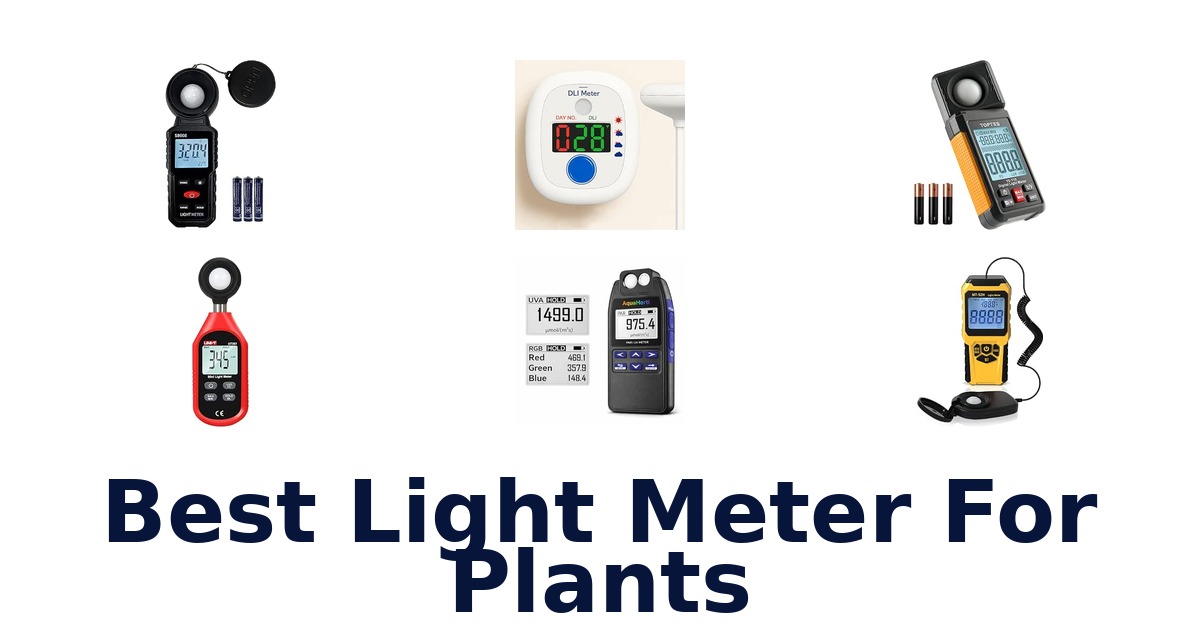
A strong light meter for plants should measure the kind of light your plants receive, with a range and readout suited to your growing space. For grow-light analysis, the AquaHorti AH-Quantuv measures PAR and UVA and separates blue, green, and red contributions; for tracking natural sunlight across the day, the EvoDevice EVO-20 records DLI and classifies exposure. General lux meters can help compare brightness around a home or greenhouse, but lux is not the same as plant-focused PAR or daily light integral.
This lineup includes specialized PAR and DLI meters alongside handheld lux meters, including models with rotating or split sensors. Use the comparison to match the meter’s measurement method and handling features to whether you are positioning houseplants, checking grow lights, or mapping garden exposure.
The AquaHorti AH-Quantuv is the strongest overall choice for growers who want plant-focused grow-light data: it measures PAR across 400–750 nm, UVA across 320–400 nm, and shows blue, green, and red PAR contributions. That makes it more informative for examining a grow light than a general-purpose lux meter. For garden placement based on sunlight accumulated through the day, choose the EvoDevice EVO-20 instead; it displays DLI, assigns a sunlight category, and stores up to 10 days of history.
Our Top Picks
 Best Overall
Measures PAR from 400–750 nm and UVA from 320–400 nm, while showing blue, green, and red PAR contributions for grow-light analysis.
View on Amazon Best DLI Tracker
Displays daily light accumulation in mol/m2/day, classifies sun exposure, and stores up to 10 days of DLI history for garden placement.
View on Amazon Best Rotating Probe
Its 180-degree rotating sensor helps measure from different angles; it covers 0.1–200,000 lux and samples every 0.5 seconds.
View on Amazon- Wide-Angle Sensor DANOPLUS DP-331
- Best Split Sensor URCERI MT-92H
Compare plant light meters by measurement type
| # | Product | Package Dimensions | Weight | Buy |
|---|---|---|---|---|
| 1 | 1. AquaHorti AH-QuantuvBest Overall | 7.4 x 4.02 x 1.65 in | 6.7 oz | View on Amazon |
| 2 | 2. EvoDevice EVO-20Best DLI Tracker | 7.32 x 3.19 x 1.73 in | 5.3 oz | View on Amazon |
| 3 | 3. TopTes TS-710Best Rotating Probe | — | 4.8 oz | View on Amazon |
| 4 |  4. DANOPLUS DP-331Wide-Angle Sensor | 7.36 x 4.84 x 2.05 in | 5.3 oz | View on Amazon |
| 5 |  5. URCERI MT-92HBest Split Sensor | 5.55 x 2.87 x 2.52 in | 7 oz | View on Amazon |
| 6 |  6. Dr.meter 1330B-VFast-response lux checks | — | 12 oz | View on Amazon |
| 7 |  7. Soonkoda S8608Flexible indoor-outdoor checks | 6.54 x 2.24 x 1.57 in | 4.6 oz | View on Amazon |
| 8 |  8. URCERI Digital Lux MeterWide-range home grow checks | — | 6.7 oz | View on Amazon |
| 9 |  9. UNI-T UT383Compact handheld lux readings | 6.73 x 2.52 x 1.65 in | 5 oz | View on Amazon |
| 10 |  10. POROMETISTO LT01Lux and FC range checks | 7.4 x 3.43 x 1.93 in | 5.6 oz | View on Amazon |
Detailed Reviews: Best Light Meter For Plants
#1 · Best Overall
1. AquaHorti AH-Quantuv
- Package Dimensions: 7.4 x 4.02 x 1.65 in
- Weight: 6.7 oz
Best for: PAR and UVA grow-light analysis.
Why it ranks #1: Measures PAR from 400–750 nm and UVA from 320–400 nm, while showing blue, green, and red PAR contributions for grow-light analysis.
Separate PAR and UVA measurements give the AquaHorti AH-Quantuv a more grow-light-specific role than a lux-only meter. It covers PAR from 400–750 nm and UVA from 320–400 nm, helping growers examine both plant-relevant light bands and how a fixture performs.
The meter displays total PAR alongside blue, green, and red contributions, so growers can inspect spectral composition rather than relying on one aggregate figure. Its UVA measurement adds another view of fixture output, useful when checking whether a grow light delivers UVA. Together, the breakdown and two measurement bands support more detailed light-distribution analysis than a simple brightness reading. It is a focused grow-light assessment tool; the supplied features do not describe daily-light-integral classification or storage of DLI history.
- Measures PAR across 400–750 nm
- Measures UVA across 320–400 nm
- Shows blue, green, and red PAR contributions
- Supports grow-light performance and distribution analysis
- Does not provide the DLI history and sunlight categories listed for EvoDevice EVO-20.
Skip it if you want a direct sunlight category and up to 10 days of DLI records; EvoDevice EVO-20 provides those functions.
This fits growers analyzing grow-light spectrum, PAR output, and UVA rather than seeking a simple ambient lux reading. Its band-specific display offers useful detail, while gardeners who prioritize sunlight categories and accumulated daily exposure should consider a DLI meter.
Full product details
| Brand | AquaHorti |
|---|---|
| Item Weight | 6.7 ounces |
| Item model number | AH-Quantuv |
| Manufacturer | De-Power |
| Package Dimensions | 7.4 x 4.02 x 1.65 inches |
Listed on Amazon as: AH-Quantuv PAR Meter for Grow Lights, PPFD Meter 400-750nm with UVA Measurement 320-400nm, Shows PAR Breakdown of Blue Green Red, Records PAR & UVA for Light Distribution Mapping
View on Amazon#2 · Best DLI Tracker
2. EvoDevice EVO-20
- Package Dimensions: 7.32 x 3.19 x 1.73 in
- Weight: 5.3 oz
Best for: Daily sunlight placement decisions.
Why it ranks #2: Displays daily light accumulation in mol/m2/day, classifies sun exposure, and stores up to 10 days of DLI history for garden placement.
The EVO-20 converts daily light integral into direct Full Sun, Partial Sun, Partial Shade, or Shade categories, enabling gardeners to make plant-placement decisions without interpreting charts. Its display also shows accumulated DLI in mol/m2/day, so the category comes with a numerical daily-light reading.
Rather than measuring only a momentary brightness level, the meter records daily DLI and stores up to 10 days of history. That record lets gardeners compare accumulated exposure across days when deciding where plants or landscape beds belong. The displayed sunlight category offers a quick interpretation, while the numerical mol/m2/day value retains the underlying measurement. Its focus is daily exposure classification; the supplied features do not list PAR color breakdown or UVA measurement for analyzing a grow-light spectrum.
- Classifies Full Sun, Partial Sun, Partial Shade, or Shade
- Displays daily DLI in mol/m2/day
- Stores up to 10 days of DLI history
- Provides sunlight categories without charts or calculations
- Does not list PAR color breakdown or UVA measurement.
Skip it if you need blue, green, and red PAR contributions plus UVA readings; AquaHorti AH-Quantuv provides those grow-light measurements.
This suits gardeners and landscape users choosing plant locations according to accumulated daily exposure rather than a single lux reading. Its categories and 10-day DLI history aid placement decisions, but it is not a spectral PAR and UVA analyzer.
Full product details
| Brand | EvoDevice |
|---|---|
| Item Weight | 5.3 ounces |
| Item model number | EVO-20 |
| Manufacturer | De-Power |
| Package Dimensions | 7.32 x 3.19 x 1.73 inches |
Listed on Amazon as: EVO-20 DLI Light Meter – Smart Sunlight Classifier for Garden & Landscape Use | Identifies Full Sun, Partial Sun, Partial Shade & Shade Based on Daily Light Integral, 10 Days of DLI History
View on Amazon#3 · Best Rotating Probe
3. TopTes TS-710
- Weight: 4.8 oz
Best for: Angled plant-canopy readings.
Why it ranks #3: Its 180-degree rotating sensor helps measure from different angles; it covers 0.1–200,000 lux and samples every 0.5 seconds.
A 180-degree rotating sensor lets the TopTes TS-710 angle its probe toward light from multiple directions, enabling more flexible checks around plants and their canopies. Its 0.5-second sampling and backlit 2.25-inch display support repeated readings and viewing in low-light conditions.
The rotating probe can be directed toward a window, lamp, or plant surface without requiring the whole meter to face the same way. Its range spans 0.1–200,000 lux and 0.1–20,000 foot-candles, with switching between units for different comparisons. Maximum and minimum recording can summarize variation over a measurement period, while data hold freezes a reading for note-taking. The 0.5-second sampling rate keeps updates frequent as you reposition the sensor.
- Sensor rotates through 180 degrees
- Measures 0.1–200,000 lux and 0.1–20,000 FC
- Records maximum and minimum illuminance
- Backlit 2.25-inch LCD with data hold
- Reports lux and foot-candles rather than PAR or daily light integral.
Skip it if you need a sunlight category based on accumulated DLI; EvoDevice EVO-20 classifies exposure and stores up to 10 days of DLI history.
The TS-710 fits growers who want to aim a rotating probe around plants and compare lux or foot-candle readings over time. Its held and maximum/minimum values help with spot checks, but it does not report PAR or daily light integral.
Full product details
| Brand | TOPTES |
|---|---|
| Item Weight | 4.8 ounces |
| Item model number | TS-710 |
| Manufacturer | TopTes |
| Dimensions | 2.17 x 0.98 x 5.51 inches |
#4 · Wide-Angle Sensor
4. DANOPLUS DP-331
- Package Dimensions: 7.36 x 4.84 x 2.05 in
- Weight: 5.3 oz
Best for: Flexible-angle sensor placement.
Why it ranks #4: The separate sensor rotates 360 degrees and measures 0–200,000 lux, offering flexible positioning around plants and in varied spaces.
A 360-degree rotating sensor lets the DANOPLUS meter point its probe in any direction, enabling light checks around plants without fixed sensor orientation. It measures from 0 to 200,000 lux, offers four lux ranges, and can switch to foot-candles.
The rotating sensor can be adjusted to face a lamp or plant surface, while the meter’s separate sensor layout supports positioning independently of the display. Auto range setting selects among 200, 2,000, 20,000, and 200,000 lux ranges, reducing the need to choose a range manually. Switching to foot-candles offers another unit for comparisons. Its stated accuracy is ±4% ±10 digits across a 400–700 nm spectral range, defining the listed measurement characteristics.
- Sensor rotates through 360 degrees
- Measures up to 200,000 lux
- Auto range setting across four lux ranges
- Switches between lux and foot-candles
- Its stated spectral range is 400–700 nm, not the wider PAR and UVA bands.
Skip it if you need UVA measurements beyond visible-light checks; AquaHorti AH-Quantuv measures UVA from 320–400 nm as well as PAR.
This fits growers who need to aim a sensor freely while taking lux or foot-candle readings around plants. Its rotating placement and auto-ranging simplify spot checks, but its listed 400–700 nm spectral range is not a UVA assessment.
Full product details
| Brand | DANOPLUS |
|---|---|
| Item Weight | 5.3 ounces |
| Item model number | DP-331 |
| Manufacturer | Danoplus |
| Package Dimensions | 7.36 x 4.84 x 2.05 inches |
#5 · Best Split Sensor
5. URCERI MT-92H
- Package Dimensions: 5.55 x 2.87 x 2.52 in
- Weight: 7 oz
Best for: Remote-probe plant measurements.
Why it ranks #5: A separate probe can reach narrow spaces while the meter measures up to 200,000 lux, with stated 0.5-second refresh rates.
A split sensor lets the URCERI MT-92H place its probe separately from the display, enabling light checks in narrow or hard-to-reach spaces. Its stated 0–200,000-lux range and 0.5-second refresh rate make it suited to examining changing illumination around crowded plant arrangements.
Position the slim remote probe where a one-piece meter may not fit, while keeping the display unit separate for easier viewing. The 0.5-second refresh rate helps track changes as you move the probe between leaves, shelves, or other tight locations. Resolution down to 0.1 lux supports fine changes in the stated range, and switchable lux/foot-candle units accommodate different measurement preferences. This split layout is the central workflow benefit, though it requires handling a separate probe and display.
- Separate probe can reach narrow spaces
- Measures from 0 to 200,000 lux
- Refreshes readings every 0.5 seconds
- Offers lux and foot-candle units
- The split-sensor setup requires positioning a separate probe and display unit.
Skip it if you prefer one compact handheld body without a separate probe; UNI-T UT383 is listed as a compact, easy-to-use meter.
The MT-92H suits growers checking light inside crowded shelves or tight plant spaces where probe placement matters. Its separated sensor aids access, but shoppers seeking a single compact handheld form should account for the probe-and-display arrangement.
Full product details
| Brand | URCERI |
|---|---|
| Item Weight | 7 ounces |
| Item model number | MT-92H |
| Manufacturer | Shenzhen Flus Technology Co.,Ltd |
| Package Dimensions | 5.55 x 2.87 x 2.52 inches |
Listed on Amazon as: MT-92H Light Meter with Split Sensor Lux/Foot Candles Meter 500ms Refresh Rates Range up to 200,000 Lux Switchable Backlight Temperature Measurer 14°F-140°F
View on Amazon#6
6. Dr.meter 1330B-V
- Weight: 12 oz
Best for: Fast-response lux checks.
Why it ranks #6: Offers lux and foot-candle conversion, fast readings at twice per second, and peak data recording for checking changes in growing areas.
Two readings per second give the Dr.meter illuminance meter a fast update cadence for checking changing light around plants. Its stated 0–200,000-lux range covers a broad range of brightness, and FC/LUX conversion lets you work in either of the two listed units.
Switching between foot-candles and lux lets you keep readings in the unit you use for your plant notes or comparisons. The twice-per-second response updates measurements rapidly as you reposition the meter, making it useful for checking multiple spots in a growing area. Its rubber material is described as cushioning and impact resistant, while the dust- and scratch-proof sensor design and a cover that closes when idle support handling and storage between measurements.
- Measures illuminance across a 0–200,000-lux range
- Updates readings twice per second
- Switches between FC and lux
- Rubber material provides cushioning and impact resistance
- Reports illuminance in FC or lux rather than PAR or daily light integral.
Skip it if you need plant-light categories based on accumulated daily exposure; EvoDevice EVO-20 reports DLI and sunlight classifications.
This is a practical fit for growers who want quick lux or foot-candle spot checks and a meter with a protected sensor for storage. It reports illuminance, so choose a DLI or PAR meter when those plant-light measures guide your decisions.
Full product details
| Brand | Dr.meter |
|---|---|
| Included Components | 1 x Light Meter |
| Item Weight | 12 ounces |
| Item model number | 1330B-V |
| Manufacturer | Dr.meter |
| Material | ABS |
| Dimensions | 4 x 1 x 8 inches |
| Style | Light Meter |
| Voltage | 9 volts |
| Additional Information | Important Information Bulb Voltage 9 volts |
Listed on Amazon as: Dr.meter Digital Illuminance Light Meter 0-200,000 Lux Range Lux Meter
View on Amazon#7
7. Soonkoda S8608
- Package Dimensions: 6.54 x 2.24 x 1.57 in
- Weight: 4.6 oz
Best for: Flexible indoor-outdoor checks.
Why it ranks #7: Its 200,000-lux maximum, automatic range conversion, and lux or foot-candle units support general brightness checks around indoor and outdoor plants.
Automatic range conversion across readings up to 200,000 lux helps the Soonkoda S8608 handle varied brightness without manual range selection. It also switches between lux and foot-candles, giving plant growers a straightforward way to compare light readings across indoor and outdoor locations.
The large display presents visible-brightness measurements, while the automatic range conversion can simplify moving between dimmer indoor areas and brighter spots. Lux and FC switching supports comparisons in either unit, and the stated MAX/MIN and data-hold functions help capture high, low, or fixed readings during a location survey. A backlight supports reading the display in lower-light settings. Its stated accuracy varies by illuminance level, and the manual is provided in English and Chinese.
- Measures up to 200,000 lux with automatic range conversion
- Switches between lux and foot-candles
- Includes MAX/MIN and data-hold functions
- Backlight supports display reading in low light
- Measures visible illuminance rather than PAR or UVA.
Skip it if you need PAR breakdown and UVA readings from grow lights; AquaHorti AH-Quantuv reports both.
Choose this for indoor or outdoor plant-location surveys where lux or foot-candle readings, range conversion, and held values are useful. Its visible-brightness measurement is not a PAR or UVA assessment, so it does not provide those grow-light details.
Full product details
| Brand | Soonkoda |
|---|---|
| Item Weight | 4.6 ounces |
| Manufacturer | Soonkoda |
| Package Dimensions | 6.54 x 2.24 x 1.57 inches |
#8
8. URCERI Digital Lux Meter
- Weight: 6.7 oz
Best for: Wide-range home grow checks.
Why it ranks #8: Measures up to 200,000 lux with stated accuracy and ambient temperature measurement, plus minimum and maximum readings for routine light checks.
A 0–200,000-lux range lets the URCERI meter cover readings from dim indoor spots to bright light, while its temperature measurement adds ambient context. For plant placement checks around the home, the color LCD and compact handheld body keep readings and the meter easy to manage.
Switch between lux and foot-candles with the FC/LUX button to work in the unit you prefer, and use MIN/MAX readings to compare light across plant locations. Data hold can preserve a reading while you note it, while automatic power-off and a low-battery indicator help manage routine use. The meter also measures ambient temperature, so you can check that alongside illumination. Above 1,000, readings default to Klux or KFc, which affects how the displayed value is expressed.
- Measures illuminance from 0 to 200,000 lux
- Measures ambient temperature as well as light
- Offers MIN/MAX readings and data hold
- Compact body with a four-digit color LCD
- Measures lux and foot-candles, not PAR or daily light integral.
Skip it if you need PAR or UVA measurements to assess grow-light output; AquaHorti AH-Quantuv measures PAR and UVA separately.
This suits home growers comparing illumination around several plants who also want an ambient temperature reading. Its broad lux range and hold function help with spot checks, but growers assessing PAR or daily light integral should choose a meter that reports those measures.
Full product details
| Brand | URCERI |
|---|---|
| Color | Yellow |
| Item Weight | 6.7 ounces |
| Item model number | 4332004118 |
| Manufacturer | URCERI |
| Dimensions | 6.87 x 2.2 x 1.2 inches |
| Size | small |
| Warranty Description | 2-Year |
Listed on Amazon as: Light Meter Digital Illuminance Meter Handheld Ambient Temperature Measurer, Range up to 200,000 Lux, Luxmeter with 4 Digit Color LCD Screen
View on Amazon#9
9. UNI-T UT383
- Package Dimensions: 6.73 x 2.52 x 1.65 in
- Weight: 5 oz
Best for: Compact handheld lux readings.
Why it ranks #9: A compact general illuminance meter with lux and foot-candle readings, 0–199,900-lux range, backlit display, and 0.5-second sampling.
A compact form and large backlit four-digit LCD make the UNI-T UT383 straightforward to carry between plant locations and read in dimmer settings. Its range reaches 199,900 lux, with lux and foot-candle display options for routine illuminance comparisons.
The 0.5-second sampling time updates readings as you move the meter between a window, shelf, or grow-light position. Max/min recording and data hold help capture variation or preserve a value while you make a note. Overload indication signals when a reading exceeds the meter's range, while auto shutdown and a low-battery indicator support ordinary handheld use. Its measurements are in lux or foot-candles, making it an illuminance tool rather than a PAR-specific analyzer.
- Measures up to 199,900 lux
- Displays readings in lux or foot-candles
- Backlit four-digit LCD
- Includes Max/Min, data hold, and overload indication
- Its 199,900-lux upper range is below meters specified to 200,000 lux.
Skip it if you need PAR breakdown and UVA readings for a grow light; AquaHorti AH-Quantuv measures PAR and UVA.
This suits growers wanting a compact handheld meter for routine lux or foot-candle checks, with held and maximum/minimum readings. Its range tops out at 199,900 lux, and its display does not provide PAR or UVA analysis.
Full product details
| Brand | UNI-T |
|---|---|
| Item Weight | 5 ounces |
| Item model number | UT38321 |
| Manufacturer | UNI-T |
| Package Dimensions | 6.73 x 2.52 x 1.65 inches |
Listed on Amazon as: UNI-T UT383 Light Meter Digital Illuminance Meter Lux Meter
View on Amazon#10
10. POROMETISTO LT01
- Package Dimensions: 7.4 x 3.43 x 1.93 in
- Weight: 5.6 oz
Best for: Lux and FC range checks.
Why it ranks #10: Measures up to 200,000 lux and 20,000 foot-candles, but the supplied details do not identify a plant-specific PAR or DLI measurement.
A dual digital and analog bar-graph display gives the POROMETISTO meter two ways to view readings, helping growers see both the numerical level and its movement. It measures up to 200,000 lux and 20,000 foot-candles for broad-range plant-light checks.
The stated range reaches from dim indoor corners to bright outdoor sunlight, making the meter relevant for comparing different plant locations. Sampling twice per second helps capture changing illumination, while the analog bar graph provides a visual indication alongside the digital reading. Its built-in green backlight supports viewing the display in lower-light settings. The product specifies accuracy under standard incandescent lamps, so that stated accuracy condition matters when interpreting measurements under other light sources.
- Measures up to 200,000 lux and 20,000 FC
- Displays digital readings and an analog bar graph
- Samples readings twice per second
- Built-in green backlight
- The stated accuracy specification applies under standard incandescent lamps.
Skip it if you need measurements of PAR and UVA bands rather than illuminance; AquaHorti AH-Quantuv measures those grow-light bands.
This suits growers who want broad lux and foot-candle coverage with a bar graph for quick visual comparison. Note that its stated accuracy is specified under standard incandescent lamps, and it does not provide the PAR and UVA readings of a grow-light analyzer.
Full product details
| Brand | POROMETISTO |
|---|---|
| Item Weight | 5.6 ounces |
| Item model number | LT01 |
| Manufacturer | POROMETISTO |
| Package Dimensions | 7.4 x 3.43 x 1.93 inches |
Listed on Amazon as: Digital Handheld Illuminance Light Meter POROMETISTO, 1-200,000 Lux
View on AmazonWhy lux can mislead when judging grow lights
A lux reading does not tell you the same thing as a plant-focused PAR reading, so a general lux meter can miss important differences between grow lights. Lux is weighted to human visual sensitivity, while the AquaHorti AH-Quantuv measures PAR across 400–750 nm and reports blue, green, and red contributions. It also measures UVA from 320–400 nm.
This difference matters when the goal is to compare a fixture’s spectral output rather than simply compare visible brightness at a spot. A high lux number alone should not be treated as proof that a light meets a crop’s needs.
The product data here does not provide a conversion method between lux and PPFD, so avoid assuming one universal conversion will apply across different lamp spectra. For general room placement, a lux meter remains useful for comparing relative brightness; for examining grow-light output, use the measurement type that matches the question.
A snapshot reading is not a full-day sunlight record
A handheld lux reading captures light at a moment, so it can miss how much a garden location receives over the whole day. The EvoDevice EVO-20 addresses that different question by measuring DLI, displaying daily accumulation in mol/m2/day, classifying exposure as full sun, partial sun, partial shade, or shade, and storing up to 10 days of history. That makes it a better fit for comparing garden or landscape placement over time than a meter designed only to show instant illuminance.
Conversely, its stated features do not describe PAR spectral breakdown or UVA measurement; choose the AquaHorti AH-Quantuv when analyzing grow-light spectrum. These tools are not interchangeable: DLI tracks accumulated daily light, while a spot measurement helps compare locations at a particular time.
For a reliable placement decision, consider whether you need a record across days or a detailed reading of a fixture, then choose the instrument accordingly.
How to Choose a Plant Light Meter
Choose the measurement that answers your question
Look first for the measurement type that matches what you need to know: grow-light spectrum, daily sunlight, or relative brightness. The AquaHorti AH-Quantuv measures PAR at 400–750 nm and UVA at 320–400 nm, and breaks PAR down into blue, green, and red. The EvoDevice EVO-20 records DLI in mol/m2/day and classifies sunlight exposure.
The other listed models primarily measure lux and often offer foot-candle conversion; those are practical for comparing brightness around a room, but are not the same as PAR or DLI. Growers checking fixture output should favour the PAR meter; gardeners choosing where to place plants outdoors should favour DLI tracking.
For routine indoor comparisons, a general lux meter may be sufficient.
Match the range and readout to the space
Check the measurement range and display functions against the light conditions you expect to measure. Many handheld choices cover about 0–200,000 lux: the TopTes TS-710 spans 0.1–200,000 lux, while the UNI-T UT383 reaches 199,900 lux. The URCERI Digital Lux Meter also measures up to 200,000 lux and includes minimum and maximum readings; the POROMETISTO LT01 adds a digital and analog bar graph.
For fluctuating light or quick comparisons, the TopTes samples every 0.5 seconds, while the Dr.meter reads twice per second. High range is useful when checking both dim indoor corners and bright areas, but it does not make a lux reading equivalent to plant-specific PAR.
Choose the display and range based on where you will take readings and how you want to compare them.
Consider how the sensor reaches the plant
Sensor movement and separation can make it easier to position a meter at the point where leaves receive light. The TopTes TS-710 has a 180-degree rotating sensor, while the DANOPLUS DP-331 specifies a separate sensor that rotates 360 degrees. The URCERI MT-92H uses a split-sensor design, with a separate probe intended for narrow spaces.
These designs can help when a display is awkward to hold near a plant, shelf, or grow-light area, though the supplied details do not state cable length or probe dimensions. A fixed or integrated handheld format may suit open spaces and quick checks; a rotating or split sensor is more useful when access and angle are the main challenges.
Check the listed product details for the actual sensor arrangement rather than assuming every handheld meter has a remote probe.
Which Plant Light Meter Should You Choose?
For grow-light analysis, choose the AquaHorti AH-Quantuv: it measures PAR and UVA and displays blue, green, and red PAR contributions. If you need to decide where to place garden plants using accumulated sunlight, the EvoDevice EVO-20 records DLI, categorizes exposure, and keeps up to 10 days of history. For ordinary indoor brightness checks, choose the TopTes TS-710 for its rotating probe and 0.1–200,000-lux range, or the DANOPLUS DP-331 if a separate 360-degree sensor suits your setup.
Tight spaces favour the split-probe URCERI MT-92H. The remaining handheld lux meters serve general illuminance comparisons, but their listed specifications do not establish PAR or DLI measurement.
Match the tool to the light question before comparing range or display features.
Related Buying Guides
- Best Water Meter For Plants
- Best Moisture Meter For Plants
- Best Artificial Light For Plants
- Best Grow Lights For Plants
- Best Uv Light For Plants
- Best Grow Lights For Indoor Plants
Frequently Asked Questions
How do I convert a plant’s recommended PPFD into a daily light target?
Multiply PPFD by the number of light hours per day, then multiply by 0.0036 to get DLI in mol/m2/day. For example, 200 μmol/m2/s for 12 hours gives 8.64 mol/m2/day. This assumes the PPFD stays constant; changing light levels require accounting for the variation over the day.
Where should I position a sensor when measuring light across a plant canopy?
Place the sensor at the height of the leaves you want to assess, with its sensing surface facing the light source. Take readings at several points across the canopy rather than relying on one spot. This reveals uneven coverage and helps you compare locations consistently.
Can a phone app replace a dedicated plant light meter for grow-light readings?
A phone app can help with rough comparisons, but it should not be treated as a substitute for a dedicated meter when accurate grow-light data matters. Phone cameras and apps may not provide calibrated PPFD, PAR, or DLI readings. Choose a meter suited to the measurement you need.
What is the difference between PAR and lux readings for plants?
Lux measures brightness as weighted for human vision, while PAR concerns light in the range used for photosynthesis. A lux reading can compare ordinary illumination, but it does not establish a grow light’s PAR or PPFD. For grow-light analysis, choose a meter that measures PAR.
When is a DLI meter useful for choosing garden plant locations?
A DLI meter is useful when you need to compare how much sunlight garden areas accumulate over a day. The EVO-20 displays DLI, assigns a sunlight category, and stores up to 10 days of history. That helps assess placement using daily exposure rather than a single reading.
Final Words
Choose the meter for the question you need answered. For grow-light analysis, the AquaHorti AH-Quantuv provides PAR, UVA, and blue, green, and red PAR contributions. For garden placement by accumulated sunlight, the EVO-20 displays DLI and records up to 10 days of history.
For ordinary indoor brightness checks, consider the TopTes TS-710 or DANOPLUS DP-331; tight spaces favour the split-probe URCERI MT-92H. General lux readings alone do not establish PAR or DLI.