
Best Low Nitrogen Fertilizer for Roots, Blooms, and Potassium
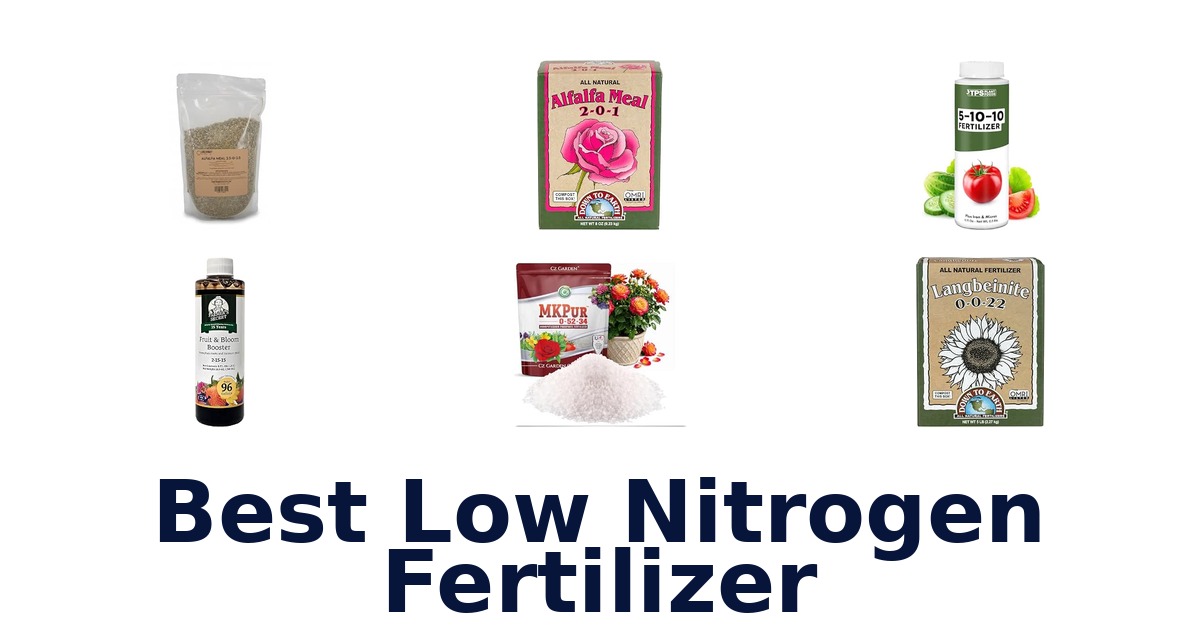
A strong low-nitrogen fertilizer supplies the phosphorus or potassium your plants need without adding more nitrogen than the situation calls for, making it useful for gardeners targeting roots, blooms, fruit, or potassium alone. The clearest option for adding phosphorus and potassium with no nitrogen is Cz Garden MKPur, a water-soluble 0-52-34 crystalline powder. For potassium without nitrogen or phosphorus, Down To Earth Langbeinite offers a 0-0-22 granular formula.
This roundup compares those targeted formulas with lower-nitrogen 5-10-10 and alfalfa meal products. Check the complete N-P-K ratio and application directions before choosing: “low nitrogen” can mean zero nitrogen, a small amount, or simply less nitrogen relative to phosphorus and potassium.
The right fit depends on which nutrient your soil and plants actually need.
Cz Garden MKPur is the strongest overall choice when you want to add phosphorus and potassium without adding nitrogen. Its 0-52-34 formula contains zero nitrogen, and its crystalline powder dissolves in water for flexible feeding. Choose it for targeted PK support during root, flowering, fruiting, or other reproductive growth stages.
If you need potassium without phosphorus, Down To Earth Langbeinite is a better match; if you prefer a low-nitrogen liquid with more balanced N-P-K numbers, TPS NUTRIENTS 5-10-10 offers that alternative.
Our Top Picks
 Best Overall
Its 0-52-34 crystalline formula supplies phosphorus and potassium with zero nitrogen, and it dissolves in water for flexible feeding.
View on Amazon Nitrogen-Free Potash
The 0-0-22 granular mineral adds potassium without nitrogen or phosphorus, suiting gardeners who specifically want potassium-focused feeding.
View on Amazon Balanced PK Liquid
This liquid 5-10-10 formula keeps nitrogen below phosphorus and potassium and is directed for reproductive-stage vegetables, flowers, and fruit trees.
View on Amazon- Phosphorus-Free Formula Greenway Alfalfa Meal
- Organic Alfalfa Meal Down To Earth Alfalfa Meal
Compare low-nitrogen fertilizer options
| # | Product | Form | Weight | Buy |
|---|---|---|---|---|
| 1 | 1. Cz Garden MKPurBest Overall | Crystalline Powder | 1 milligrams | View on Amazon |
| 2 | 2. Down To Earth LangbeiniteNitrogen-Free Potash | Granules | 5.3 lb | View on Amazon |
| 3 | 3. TPS NUTRIENTS 5-10-10Balanced PK Liquid | Liquid | — | View on Amazon |
| 4 |  4. Greenway Alfalfa MealPhosphorus-Free Formula | Powder | — | View on Amazon |
| 5 |  5. Down To Earth Alfalfa MealOrganic Alfalfa Meal | Powder | 8 oz | View on Amazon |
| 6 |  6. Farmer's Secret Fruit & BloomConcentrated fruit and bloom feeding | Liquid | 11.2 oz | View on Amazon |
Detailed Reviews: Best Low Nitrogen Fertilizer
#1 · Best Overall
1. Cz Garden MKPur
- Form: Crystalline Powder
- Weight: 1 milligrams
Best for: Zero-nitrogen PK supplementation.
Why it ranks #1: Its 0-52-34 crystalline formula supplies phosphorus and potassium with zero nitrogen, and it dissolves in water for flexible feeding.
A 0-52-34 analysis supplies phosphorus and potassium with zero nitrogen, enabling targeted PK feeding without adding nitrogen. Cz Garden MKPur is a water-soluble crystalline powder listed for blooms, roots, fruits, vegetables, hydroponics, and fertigation, making it a focused option when those nutrients—not a complete nutrient supply—are the goal.
The zero-nitrogen formula is useful when a grower wants to add phosphorus and potassium without increasing nitrogen at the same time. Its water-soluble form dissolves in water for flexible feeding, and the title lists soil, hydroponics, and fertigation applications, so it can fit several growing workflows. With 52 phosphorus and 34 potassium in the stated analysis, it targets root development, flowering, fruiting, and reproductive growth rather than supplying nitrogen for foliage.
- 0-52-34 formula contains zero nitrogen.
- High phosphorus and potassium levels target PK supplementation.
- Water-soluble crystalline powder dissolves in water.
- Listed for soil feeding, hydroponics, and fertigation.
- Zero nitrogen means it cannot supply nitrogen when plants need that nutrient.
Skip it if you need nitrogen alongside PK; TPS Nutrients 5-10-10 provides nitrogen as well as higher phosphorus and potassium.
Choose MKPur when you specifically need phosphorus and potassium without additional nitrogen, including for listed hydroponic or fertigation workflows. Its zero-nitrogen analysis makes it a targeted supplement, not a standalone source of all plant nutrients.
Full product details
| Brand | Cz Garden Supply |
|---|---|
| Item Form | Crystalline Powder |
| Item Weight | 1 milligrams |
| Manufacturer | Cz Garden Supply |
| Model Number | CzMKPur |
Listed on Amazon as: Cz Garden MKPurTM 0-52-34 Monopotassium Phosphate Fertilizer – Water Soluble PK Plant Food for Blooms, Roots, Fruits, Vegetables, Hydroponics & Fertigation – Zero Nitrogen
View on Amazon#2 · Nitrogen-Free Potash
2. Down To Earth Langbeinite
- Form: Granules
- Weight: 5.3 lb
Best for: Nitrogen-free potassium supplementation.
Why it ranks #2: The 0-0-22 granular mineral adds potassium without nitrogen or phosphorus, suiting gardeners who specifically want potassium-focused feeding.
A 0-0-22 analysis delivers potassium without nitrogen or phosphorus, enabling targeted potassium supplementation when those other nutrients are not wanted. Down To Earth’s naturally mined langbeinite also supplies magnesium and sulfur in water-soluble sulfate form, giving growers three listed nutrients from one granular mineral amendment.
The granular form offers a distinct handling option for soil application, while the listed water-soluble sulfate form supplies potassium, magnesium, and sulfur. Its neutral pH does not alter soil activity, and the stated maximum chlorine content below 3.0 percent is noted as minimizing fertilizer-burn potential. Since the analysis is 0-0-22, this product targets potassium rather than nitrogen or phosphorus; it fits a nutrient plan that accounts for those needs separately.
- 0-0-22 analysis supplies potassium without nitrogen or phosphorus.
- Provides potassium, magnesium, and sulfur in sulfate form.
- Granular form suits growers choosing a solid mineral amendment.
- Neutral pH does not alter soil activity.
- The 0-0-22 analysis supplies neither nitrogen nor phosphorus.
Skip it if you need nitrogen with potassium; Down To Earth Organic Alfalfa Meal 2-0-1 provides nitrogen and potassium.
Choose langbeinite when your feeding plan calls for potassium, magnesium, and sulfur but not nitrogen or phosphorus. Its granular mineral form and neutral pH may suit soil use, but the 0-0-22 analysis requires other sources for N and P.
Full product details
| Brand | Down To Earth All Natural Fertilizers |
|---|---|
| Included Components | grass-plants |
| Item Form | Granules |
| Item Weight | 5.3 pounds |
| Manufacturer | Hawthorne Hydroponics, LLC |
| Model Number | 07852 |
| Additional Information | Important information Safety Information safety_warning Ingredients plant nutrients Directions Not_Applicable |
Listed on Amazon as: Down To Earth All Natural Fertilizers Organic Langbeinite – 0-0-22, 5 lb
View on Amazon#3 · Balanced PK Liquid
3. TPS NUTRIENTS 5-10-10
- Form: Liquid
Best for: Flowering and fruiting gardens.
Why it ranks #3: This liquid 5-10-10 formula keeps nitrogen below phosphorus and potassium and is directed for reproductive-stage vegetables, flowers, and fruit trees.
A 5-10-10 liquid formula puts phosphorus and potassium above nitrogen, a balance that suits gardeners supporting roots and plant development during reproductive growth. TPS Nutrients lists vegetables, tomatoes, flowers, garden beds, and landscapes among its intended uses, giving this concentrate a broad outdoor role rather than a single-crop focus.
Mixing is straightforward: the directions call for 1 tablespoon per gallon of water, applied with a watering can or hose-end sprayer. That gives gardeners two listed ways to distribute the liquid across garden vegetables, flowering plants, or fruit trees during their reproductive stage. The higher phosphorus and potassium levels are tied to root strength and plant development, while the 5-10-10 ratio keeps nitrogen below both other listed nutrients. Applications can be repeated as needed.
- 5-10-10 ratio supplies more phosphorus and potassium than nitrogen.
- Liquid form can be applied with a watering can or hose-end sprayer.
- Listed for garden beds, landscapes, and backyard growing.
- Directions specify use during reproductive growth for vegetables, flowers, and fruit trees.
- Directions target reproductive-stage use, so it is not presented as an all-stage feeding routine.
Skip it if you need a zero-nitrogen PK feed; Cz Garden MKPur 0-52-34 supplies phosphorus and potassium without nitrogen.
Choose this liquid for outdoor gardeners feeding vegetables, flowers, or fruit trees during reproductive growth, especially when a watering can or hose-end sprayer suits the routine. Its directions specify that stage rather than continuous, all-season feeding.
Full product details
| Brand | TPS NUTRIENTS |
|---|---|
| Item Form | Liquid |
| Manufacturer | TPS Nutrients |
| Additional Information | Important information Directions Apply 1 tablespoon per gallon of water and use during the reproductive stage of growth for flowering annuals, perennials, fruit trees, and garden vegetables. Repeat applications as needed. Use a watering can or hose-end sprayer for application. |
Listed on Amazon as: 5-10-10 Fertilizer – Great for Vegetables, Tomatoes & Flowers, 8oz
View on Amazon#4 · Phosphorus-Free Formula
4. Greenway Alfalfa Meal
- Form: Powder
Best for: Phosphorus-free rose and garden feeding.
Why it ranks #4: Its 2.5-0-2.5 formula supplies modest nitrogen and potassium without phosphorus, and directions include monthly use for rose bushes.
A phosphorus-free 2.5-0-2.5 alfalfa meal pairs nitrogen with potassium, enabling feeding where soil already has adequate phosphorus or runoff is a concern. Greenway Biotech adds triacontanol, described as promoting basal breaks and blooming, making this powder especially relevant to rose growers seeking new canes and flowers.
For rose bushes, the listed direction is 1 cup monthly during the growing season, while small gardens use 1–2 cups per 10 square feet every 4–6 weeks, mixed into topsoil and watered thoroughly. Those distinct routines help buyers match application to planting scale. The powder’s nitrogen and potassium support foliage and bloom quality, while zero phosphorus suits phosphorus-adequate soils. Its triacontanol growth stimulant is specifically associated with basal breaks and prolific blooming in roses.
- 2.5-0-2.5 analysis supplies nitrogen and potassium with zero phosphorus.
- Contains triacontanol, associated with rose basal breaks and blooming.
- Directions give separate routines for rose bushes and small garden areas.
- Powder is described as low-odor.
- Zero phosphorus makes it unsuitable as a phosphorus source for deficient soil.
Skip it if you need phosphorus for a deficient soil; Cz Garden MKPur 0-52-34 supplies phosphorus and potassium without nitrogen.
Choose this alfalfa meal for rose growers and gardeners who want nitrogen and potassium without adding phosphorus, particularly where soil already has adequate P. Follow the scale-specific directions and account for its phosphorus-free formula.
Full product details
| Brand | Greenway Biotech, Inc. |
|---|---|
| Item Form | Powder |
| Manufacturer | Greenway Biotech, Inc. |
| Model Number | TRTAZ11A |
Listed on Amazon as: Greenway Biotech, Inc. Organic Alfalfa Meal Fertilizer 2.5-0-2.5 | Rose & Vegetable Plant Food with Triacontanol Growth Stimulant | Non-GMO, Phosphorus-Free | 1 Pound
View on Amazon#5 · Organic Alfalfa Meal
5. Down To Earth Alfalfa Meal
- Form: Powder
- Weight: 8 oz
Best for: Organic slow-release garden feeding.
Why it ranks #5: This organic, OMRI Listed 2-0-1 powder provides slow-release nitrogen and potassium, but it is not nitrogen-free.
A 2-0-1 analysis supplies slow-release nitrogen and potassium, enabling sustained feeding without adding phosphorus. Down To Earth’s alfalfa meal is OMRI listed for organic gardening and includes triacontanol, vitamins, and trace minerals, giving organic growers a powder option for roses, bulbs, flowers, ornamentals, and vegetables.
The slow-release nitrogen and potassium support sustained plant growth, while the listed triacontanol, vitamins, and trace minerals add a broader set of components associated with plant vigor. The powder is also described as improving soil microbial activity and structure, which can support nutrient availability through soil conditions rather than only direct feeding. Its OMRI listing makes it suitable for organic gardening practices. With a 2-0-1 analysis, it contributes no phosphorus, so it is not a complete N-P-K source.
- 2-0-1 formula provides slow-release nitrogen and potassium.
- OMRI listed for organic gardening.
- Contains triacontanol, vitamins, and trace minerals.
- Described as improving soil microbial activity and structure.
- The 2-0-1 analysis supplies no phosphorus.
Skip it if you need phosphorus in the same application; Greenway Biotech Alfalfa Meal 2.5-0-2.5 is likewise phosphorus-free, so select a PK source instead.
Choose this powder for organic gardeners seeking slow-release nitrogen and potassium alongside soil-structure support for ornamentals or vegetables. Its phosphorus-free 2-0-1 analysis suits feeding plans that source phosphorus separately, not those requiring complete N-P-K nutrition.
Full product details
| Brand | Down To Earth All Natural Fertilizers |
|---|---|
| Item Form | Powder |
| Item Weight | 8 ounces |
| Manufacturer | Down To Earth All Natural Fertilizers |
| Model Number | 17805 |
Listed on Amazon as: Down to Earth All Natural Fertilizers Organic Alfalfa Meal – Plant Food for Roses, Bulbs, Flowers and Ornamentals 2-0-1, 0.5 lb
View on Amazon#6
6. Farmer's Secret Fruit & Bloom
- Form: Liquid
- Weight: 11.2 oz
Best for: Concentrated fruit and bloom feeding.
Why it ranks #6: It targets blooms and fruit with high phosphorus and potassium, but the listed data gives no N-P-K ratio to verify how low its nitrogen is.
A super-concentrated liquid with high phosphorus and potassium focuses this fertilizer on fruit and bloom production, enabling feeding across fruit-, vegetable-, and flower-producing plants. Farmer’s Secret also links its phosphorus concentration to root development and nutrient uptake, giving it a reproductive-growth role across crops including citrus, roses, and raspberries.
The concentrate is diluted at 1 teaspoon per 2 gallons of water, then applied during regular watering every 2–4 weeks. That schedule makes it possible to include fruit trees, vegetables, and flowers in an established watering routine rather than applying the product undiluted. Its high phosphorus and potassium are described as supporting roots and fruit or bloom production. The ingredients include nitrogen, but no nitrogen ratio is supplied, so buyers cannot assess its exact nitrogen contribution from the listed analysis.
- Super-concentrated liquid is diluted at 1 teaspoon per 2 gallons of water.
- High phosphorus and potassium support fruit and bloom production.
- Listed for fruit-, vegetable-, and flower-producing plants.
- Application every 2–4 weeks fits a regular watering routine.
- The listing includes nitrogen but gives no nitrogen ratio for precise low-nitrogen planning.
Skip it if you require a stated zero-nitrogen analysis; Cz Garden MKPur 0-52-34 provides phosphorus and potassium with no nitrogen.
Choose this concentrate for a regular watering routine across fruiting, flowering, and vegetable plants when bloom and yield support are priorities. Its nitrogen amount is not stated, so it is a poor fit when a precise low-nitrogen ratio is essential.
Full product details
| Brand | Farmer's Secret |
|---|---|
| Included Components | Plant Fertilizer |
| Item Form | Liquid |
| Item Weight | 11.2 ounces |
| Manufacturer | Farmer's Secret |
| Additional Information | Important information Ingredients Nitrogen, Phosphorus, Potassium Directions 1. Dilute the concentrate at a rate of 1 teaspoon per 2 gallons of water. 2. Apply it during regular watering every 2-4 weeks. 3. Use it on all flower/fruit/vegetable producing plants. |
Listed on Amazon as: Farmer’s Secret Fruit & Bloom Booster Fertilizer – Super Concentrated – Boosts Flowering and Yield on All Varieties of Fruits, Vegetables and Flowers (8oz)
View on AmazonAvoid choosing by the word low alone
“Low nitrogen” does not tell you which nutrient a fertilizer supplies, so check the full N-P-K ratio before applying it. Cz Garden MKPur is 0-52-34: it adds substantial phosphorus and potassium but no nitrogen. Down To Earth Langbeinite is 0-0-22, adding potassium without phosphorus.
TPS NUTRIENTS 5-10-10 contains nitrogen, but its phosphorus and potassium values are higher. These are not interchangeable choices.
A key failure mode is adding phosphorus when a garden already has enough: the zero-phosphorus Greenway Alfalfa Meal may fit that situation better, though it still supplies nitrogen and potassium. Product descriptions identify intended uses, but none of the supplied data establishes what a particular soil needs. Use a soil test or other reliable assessment to identify the nutrient target, then match the ratio rather than relying on the product name or a general bloom claim.
Match the application form to your routine
A fertilizer’s form affects how you prepare and apply it, so do not assume all low-nitrogen products use the same method. The liquid TPS NUTRIENTS 5-10-10 directions call for 1 tablespoon per gallon of water during reproductive growth, while Farmer’s Secret Fruit & Bloom calls for 1 teaspoon per 2 gallons every 2–4 weeks. Cz Garden MKPur is a water-soluble crystalline powder, but the supplied product information does not give a mixing rate.
The alfalfa meals are powders with soil-application directions; Greenway specifies mixing into topsoil for garden beds, while Down To Earth’s supplied information identifies a powder but does not provide a complete rate. Langbeinite is granular, and its supplied directions are listed as not applicable.
A practical trap is treating a product’s general plant-use claim as a complete application plan. Verify the label directions for your plant and growing setup before using it.
How to Choose Low-Nitrogen Fertilizer
Nitrogen level and nutrient balance
Look for the complete N-P-K ratio and decide whether you need no nitrogen or just a lower proportion. The listed range runs from zero nitrogen in Cz Garden MKPur 0-52-34 and Down To Earth Langbeinite 0-0-22 to 2-0-1 in Down To Earth Alfalfa Meal, 2.5-0-2.5 in Greenway Alfalfa Meal, and 5-10-10 in TPS NUTRIENTS 5-10-Farmer’s Secret Fruit & Bloom is described as high in phosphorus and potassium, but no ratio is supplied.
Choose a zero-nitrogen product when you want to avoid adding nitrogen; choose the alfalfa formulas when a small amount is acceptable. The 5-10-10 option suits buyers seeking a liquid with all three nutrients rather than a nitrogen-free feed.
Which nutrient you need to add
Choose a formula based on whether your target is phosphorus, potassium, or both, rather than assuming every low-nitrogen fertilizer serves the same purpose. Cz Garden MKPur’s 0-52-34 provides phosphorus and potassium with neither omitted; Langbeinite’s 0-0-22 provides potassium but no phosphorus. TPS NUTRIENTS 5-10-10 supplies both, with phosphorus and potassium each higher than nitrogen.
Both alfalfa meals contain no phosphorus: Greenway is 2.5-0-2.5, while Down To Earth is 2-0-If phosphorus is already adequate or you want to avoid adding it, consider the zero-phosphorus options.
If you need a high-phosphorus, high-potassium product without nitrogen, Cz Garden MKPur is the clearest fit. A soil test can help establish which situation applies.
Application form and directions
Choose a form and application method you can use correctly, and confirm the label gives instructions that suit your setup. Cz Garden MKPur is a water-soluble crystalline powder; TPS NUTRIENTS 5-10-10 is liquid and specifies 1 tablespoon per gallon of water. Farmer’s Secret Fruit & Bloom is a concentrate directed at 1 teaspoon per 2 gallons every 2–4 weeks.
Greenway and Down To Earth Alfalfa Meal are powders, while Langbeinite is granular. The supplied Greenway directions give a garden-bed rate of 1–2 cups per 10 square feet every 4–6 weeks, mixed into topsoil.
Buyers who prefer a measured liquid dilution may favor TPS NUTRIENTS 5-10-10 or Farmer’s Secret Fruit & Bloom; those who want a soil-mixed powder may prefer Greenway Alfalfa Meal. Follow the specific product label rather than transferring one product’s rate to another.
Which low-nitrogen fertilizer should I choose?
For phosphorus and potassium without nitrogen, choose Cz Garden MKPur; its 0-52-34 ratio and water-soluble crystalline form make it the clearest all-around match. If you need potassium alone and want to avoid phosphorus too, Down To Earth Langbeinite supplies 0-0-Choose TPS NUTRIENTS 5-10-10 if you want a liquid with all three nutrients and directions for reproductive-stage use.
For a small nitrogen contribution with no phosphorus, Greenway Alfalfa Meal offers 2.5-0-2.5 and rose-specific directions. Down To Earth Alfalfa Meal is an organic 2-0-1 option with slow-release nitrogen.
Farmer’s Secret Fruit & Bloom is aimed at fruit and blooms, but its listed facts omit the N-P-K ratio, so it is harder to verify as a low-nitrogen choice. Match the product to your actual nutrient need.
Frequently Asked Questions
How can I tell whether my soil needs phosphorus, potassium, or both?
A soil test is the most reliable way to identify a phosphorus or potassium need. Check its nutrient results and recommendations before choosing a product; symptoms alone can be misleading. If testing is not practical, consult a local extension service about suitable testing options for your garden and soil.
When should I avoid adding phosphorus to garden soil?
Avoid adding phosphorus when a soil test shows adequate or excessive levels, unless a qualified local recommendation says otherwise. Extra phosphorus may build up rather than solve a plant problem. Check fertilizer labels carefully: a product such as MKPur adds both phosphorus and potassium, while Langbeinite is listed as 0-0-22.
How should I adjust fertilizer application for containers versus garden beds?
Follow the product label for either setting, and do not assume a garden-bed amount applies to a container. Containers hold a limited volume of growing medium, so measure carefully and account for any fertilizer already present. For beds, consider soil-test recommendations and the area being treated; avoid applying more than directed.
What does a fertilizer’s N-P-K ratio tell me?
The N-P-K ratio lists the relative amounts of nitrogen, phosphorus, and potassium in that order. For example, the listed 0-52-34 formula has zero nitrogen, while 0-0-22 lists potassium without phosphorus or nitrogen. Compare the numbers with your soil needs rather than choosing by a product’s name alone.
What if a product does not list its N-P-K ratio?
Treat the nutrient balance as unverified when the listed facts omit an N-P-K ratio. Farmer’s Secret Fruit & Bloom is described as a fruit-and-bloom booster, but its listed facts do not provide the ratio, making its nitrogen level harder to confirm. Choose a product with a stated analysis when low nitrogen is essential.
Final Words
Start with a soil test, then select the nutrient combination your plants actually need. For phosphorus and potassium without nitrogen, Cz Garden MKPur is the clearest overall match; choose Langbeinite when you need potassium without phosphorus. TPS NUTRIENTS 5-10-10 is the liquid alternative with all three nutrients.
Alfalfa meals contribute some nitrogen, while Farmer’s Secret has no listed N-P-K ratio, so its nitrogen level is harder to verify.